Global Infrastructure, AZs, and Regions
Explore how AWS's global infrastructure supports high availability, low latency, and fault tolerance through its system of regions, availability zones, and edge locations. Understand the strategic deployment of data centers worldwide and how these components contribute to efficient cloud service delivery.
We'll cover the following...
When deploying services and applications on the cloud, organizations demand high availability, low network latency, and cost-effectiveness. However, these can only be offered if the data centers are strategically dispersed around the globe. AWS has built a resilient and highly available infrastructure by dividing the infrastructure among regions and availability zones.

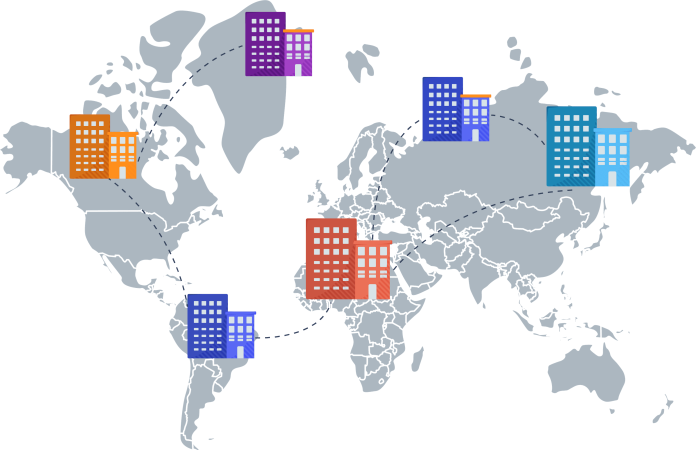
Global infrastructure
AWS operates a vast global infrastructure comprising data centers, networking facilities, and edge locations strategically positioned worldwide. This infrastructure forms the backbone of AWS services, enabling businesses and organizations to leverage cloud computing resources reliably and efficiently. The global structure of AWS contains four important components, as shown in the figure below.


Regions and Availability Zones (AZs)
AWS divides the world into geographic regions, each consisting of multiple Availability Zones (AZs). Regions are isolated from one another and are designed to provide low-latency access to AWS services for customers in specific geographic areas. AWS regions include North America, South America, Europe, the Middle East, Africa, Asia Pacific, Australia, and New Zealand, and they're expanding. Each region is connected to the other through a high bandwidth, fully redundant network.


Each Region consists of at least three Availability Zones (some older Regions have more). Each Availability Zone has data centers with redundant power sources and networks. The distance of each Availability Zone from the other is such that it is distant enough to be fault-tolerant and close enough to replicate with millisecond latency.
Points of Presence and regional edge caches
Points of Presence (PoP), also known as edge locations, are located in major cities worldwide. AWS uses these edge locations to cache content, reducing latency and improving end user performance. PoPs are connected to the AWS Regions through the AWS network backbone and are isolated from one another.


If the data is not accessed frequently enough to be stored on a PoP, it is stored on a regional edge cache. The regional edge cache has more capacity than the individual PoP. It lies in the middle of the origin server and a PoP and stores content that has become less popular over a period of time. The global infrastructure has been designed to ensure high availability and resilient applications.
Local caches operate inside the application infrastructure, often in-memory, and provide microsecond-level latency for frequently accessed data. They store data close to the compute or database layer to speed up backend operations and reduce repeated requests to slower or more expensive data sources.
Tip: While choosing Regions and Availability Zones, it is recommended to consider factors like proximity to users, data redundancy, cost optimization, and service availability.