Problem: Linked List Cycle IV
Statement
Given the head of a singly linked list, implement a function to detect and remove any cycle present in the list. A cycle occurs when a node's next pointer links back to a previous node, forming a loop within the list.
The function must modify the linked list in place, ensuring it remains acyclic while preserving the original node order. If no cycle is found, return the linked list as is.
Constraints:
The number of nodes in the list is in the range
. Node.value
Examples


Understand the problem
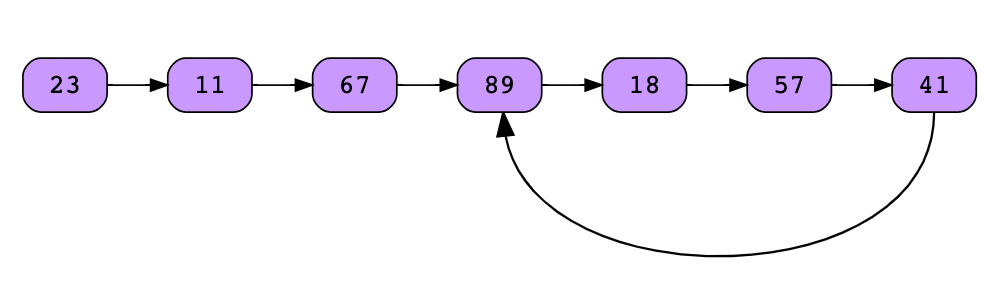
Figure it out!
Try it yourself
Problem: Linked List Cycle IV
Statement
Given the head of a singly linked list, implement a function to detect and remove any cycle present in the list. A cycle occurs when a node's next pointer links back to a previous node, forming a loop within the list.
The function must modify the linked list in place, ensuring it remains acyclic while preserving the original node order. If no cycle is found, return the linked list as is.
Constraints:
The number of nodes in the list is in the range
. Node.value