How to calculate the product in MS Excel
In Microsoft Excel, the PRODUCT function calculates the product of all numbers in a given range or array. It’s commonly used to find the total multiplication result of a series of values, making it handy for various financial, engineering, and statistical calculations within spreadsheets. Simply input the range or array of numbers as arguments, and Excel swiftly computes the product.
Syntax
The basic syntax for the PRODUCT function is as follows:
=PRODUCT(number1, number2,...)
Here, number1 and number2 represents the cell number or any numeric value. It’s worth noting that we have the flexibility to include additional cells as needed.
Note: Ranges or cell references may be used instead of explicit values.
Simple values
If we simply want to find out the product between 10, 20, and 30 we will use the PRODUCT function using the formula below:
=PRODUCT(10,20,30,10)
List of cells
If we want to find the product by providing the list of cells, we can use the formula below:
=PRODUCT(A1,A2,A3)
Range of cells
If we want to find the product by providing the range of cells, we can use the formula below:
=PRODUCT(A1:A3)
If we want to use the range of cells, and skip a cell number in that case we can use the formula below:
=PRODUCT(A1:A3,A5)
The above formula calculates product of cells A1, A2, A3, and A5.
Steps
The following is a step-by-step guide to using the PRODUCT function:
Select the cell: We click the cell where we want to calculate the product.
Use the
PRODUCTfunction: We type=PRODUCT(into the selected cell.Select the range: If we want to calculate the product of the number of cells in the range A1 to A5, there are two ways to achieve the desired result:
We can enter “A1:A5” after the opening parenthesis and then close the parenthesis and press “Enter.” The formula should look something like this:
=PRODUCT(A1:A5).We can also enter A1,A2,A3,A4,A5 after the opening parenthesis and then close the parenthesis and press “Enter.” The formula should look something like this:
=PRODUCT(A1,A2,A3,A4,A5).
Let's now apply the steps above on our dataset. Let's suppose we have the following dataset:

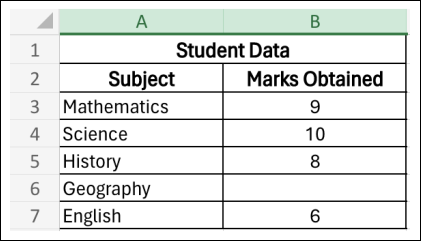
Now, our objective is to determine the product of the marks a student receives in the provided dataset. We have discussed two methods to calculate the product. Let’s use both methods:
Using the PRODUCT function with list of cells
First, we select the cell, where we need to calculate the product. Let's suppose here the cell number is B9. After we select the “cell(B9),” write the following in the cell:
=PRODUCT(B3,B4,B5,B6,B7)
Let's visualize the steps above in action.

Note:
As we can see in the slides above, when multiple cells are added, the system automatically highlights the cell number and alters its color for easier identification.
If an empty cell is included in a product formula and subsequently populated with a value, the value in “cell B9,” where the product is calculated, will automatically update to reflect the new value.
Using the PRODUCT function by specifying the range
First we select the cell, where we need to calculate the product. Let's suppose here the cell number is B9. After we select the “cell(B9),” write the following in the cell:
=PRODUCT(B3:B7)
Let's visualize the steps above in action.

Note: To skip any subject, let’s say “Geography,” we can simply write the range formula as follows:
=PRODUCT(B3:B5,B7)
Things to remember
If we try to find the product of any value (other than numbers) enclosed in double quotes, it will throw a
#VALUE!error.Empty cells, text, the logical values
TRUEandFALSE, and text values are all ignored when used with a range or by typing the cell numbers.
Unlock your potential: MS Excel essentials series, all in one place!
To deepen your understanding of MS Excel, explore our series of Answers below:
How to create MS Excel files using Python
Learn how to generate and manipulate Excel files using Python libraries likeopenpyxlandpandas.How to create MS Excel files using Julia
Discover how to create and modify Excel files using Julia with packages likeXLSX.jlfor data analysis.Common aggregate functions in MS Excel
Explore key aggregate functions like SUM, AVERAGE, MAX, and MIN to perform data calculations efficiently.How to count values in MS Excel
Learn to count cells, numbers, and specific values using functions likeCOUNT,COUNTA, andCOUNTIF.How to calculate sum in MS Excel
Use theSUMfunction to add numbers across rows, columns, and custom ranges.How to calculate average in MS Excel
Apply theAVERAGEfunction to find the mean of a dataset quickly.How to calculate maximum in MS Excel
Learn how to use theMAXfunction to find the highest value in a range.How to calculate the product in MS Excel
Use thePRODUCTfunction to multiply values in a selected range.How to calculate the median in MS Excel
Understand how theMEDIANfunction determines the middle value in a dataset.How to calculate minimum in MS Excel
Use theMINfunction to identify the smallest value within a range.How to calculate the mode in MS Excel
Find the most frequently occurring value using theMODEfunction.Calculate student grades from percentage in MS Excel
Learn how to automate grade calculation using conditional formulas likeIF,LOOKUP, andVLOOKUP.
Free Resources