How to draw a line chart in Altair
Altair is a Python library for declarative data visualization. It provides a high-level interface for creating interactive and informative visualizations from data. Altair is built on top of Vega and Vega-Lite, which are visualization grammars designed to make it easier to generate visualizations in a consistent and concise manner.


Line chart in Altair
In Altair, a line chart is a type of data visualization that represents data points as connected line segments. It is often used to display how a particular variable changes over a continuous or ordinal range of values, typically along the x-axis. Line charts are especially useful for showing trends, patterns, and changes in data over time or across ordered categories.

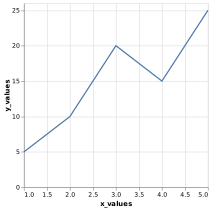
To draw a line chart in Altair, we’ll need to follow these general steps:
Importing Altair: We import the Altair library in our Python code. We need a dataset to visualize. We can use pandas or other data manipulation libraries to load our data.
import altair as altimport pandas as pd# Load your data into a Pandas DataFramedata = pd.read_csv('your_data.csv')
Creating an Altair chart: We use the
alt.Chartfunction to create the base chart object. We pass our data to this function.
chart = alt.Chart(data)
Encoding the data: For a line chart, we typically map our
x-valuesto the x-axis and oury-valuesto the y-axis. We can also customize the line style, color, and other visual attributes.
line = chart.mark_line().encode(x='x_values',y='y_values')
Customizing the chart: We can add various customizations to our line charts, such as axis labels, titles, tooltips, and color schemes.
line = line.properties(title='Line Chart Example',).encode(tooltip=['x_values', 'y_values'],)
Example
Let’s create a basic line chart in Altair using sample data.
import altair as altimport pandas as pdimport os# Create a sample DataFramedata = pd.DataFrame({'x_values': [1, 2, 3, 4, 5],'y_values': [10, 20, 15, 30, 25]})chart = alt.Chart(data).mark_line().encode(x='x_values',y='y_values').properties(title='Line Chart',).encode(tooltip=['x_values', 'y_values'],)chart.save('chart.html')os.system('cat chart.html')
Explanation
Lines 1–3: We import Altair and the necessary libraries.
Lines 5–9: We create a pandas DataFrame named
datawithx_valuesandy_valuescolumns.Lines 11–18: We initialize an Altair chart with data. We specify that it’s a line chart (
mark_line) and mapsx_valuesto the x-axis andy_valuesto the y-axis. We set the charttitleand addtooltips.Line 20: We save the chart using
chart.save('chart.html'). It exports the chart to an HTML file namedchart.html.Line 21: We display the chart on the console.
Unlock your potential: Data visualization with the Altair series, all in one place!
To continue your exploration of data visualization using the Altair library, check out our series of Answers below:
Data visualization using the Python Altair library
Get an introduction to Altair, its purpose, installation, and basic usage for data visualization.What are the main elements of an Altair chart?
Learn about the key components that make up an Altair chart and how they contribute to creating meaningful visualizations.How to implement encoding in Altair
Understand how encoding is used to map data to visual properties.How to draw a line chart in Altair
Discover how to create a simple yet effective line chart using Altair.How to draw a bar chart in Altair
Understand how to create bar charts in Altair for comparing categories and visualizing data values.How to draw a scatter plot in Altair
Explore the process of creating scatter plots in Altair to visualize relationships between variables.How to draw a box plot in Altair
Learn how to create box plots in Altair for displaying the distribution of data through quartiles.How to draw a heatmap in Altair
Discover how to create heatmaps in Altair to represent data intensity and patterns using color coding.How to draw a stacked area chart in Altair
Understand how to create stacked area charts in Altair to visualize cumulative data over time.How to draw a geographical map in Altair
Learn how to visualize geographical data and create interactive maps using Altair’s geospatial capabilities.How to draw a pie chart in Altair
Discover how to create pie charts in Altair, ideal for visualizing proportions of a whole.
Free Resources