How to solve the N-rooks problem
The N-rooks problem is a classic combinatorial puzzle in


Before diving into this Answer, learners should have a basic understanding of chess and some familiarity with concepts related to constraint satisfaction problems.
Understanding the problem
The N-Rooks problem is a puzzle that asks the following question: Given an N×N chessboard, how can we place N rooks on the board so that no two rooks threaten each other? The goal is to place N rooks on the board so that no two rooks share the same row or column because they can attack any piece coming in their path.
Rules and constraints
To solve the N-rooks problem, we need to follow these constraints:
No rook conflict: No two rooks should be in the same row or column, ensuring that no rooks threaten each other.
N rooks: Exactly N rooks must be placed on the N×N chessboard.

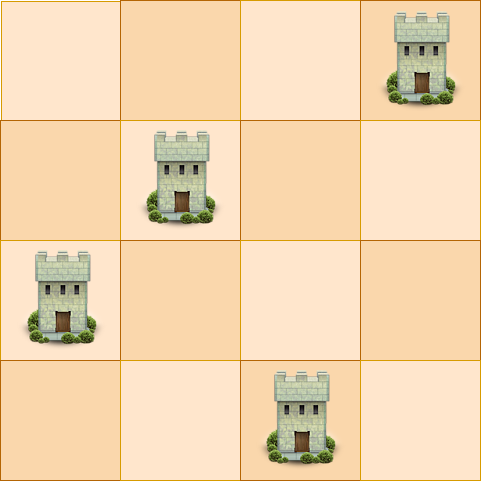
Strategies for solving the N-Rooks problem
Solving the N-rooks problem can be approached in several ways, including:
Backtracking: This is a common technique for solving constraint satisfaction problems like the N-rooks problem. It involves placing rooks on the board individually to satisfy the constraints. The algorithm backtracks and tries a different placement if a conflict is encountered.
Recursion: Many solutions for the N-rooks problem are recursive. We can think of the problem as placing a rook in the first row and then recursively solving a smaller N-1 rook problem for the remaining rows.
Mathematical combinatorics: Mathematical formulas and combinatorial techniques can calculate the number of possible solutions for the N-rooks problem without explicitly generating each solution.
Note: The N-rooks problem can have multiple solutions for a single NxN dimension.
In this Answer, we will discuss the recursion approach for the N-Rooks problem.
Why recursion?
Recursion is a compelling choice for solving the N rooks problem due to the inherent structure of the problem itself. This problem naturally lends itself to recursive exploration, as the task can be broken down into subproblems of placing rooks on smaller chessboards. We can construct a solution for the larger chessboard by recursively solving these subproblems. Below is an illustration of how recursion works:


Recursive code example
Let’s look at a Python code example to check if a solution exists for a specific NxN size of the N-rooks problem.
def safe(board, row, col):for i in range(row):if board[i][col] == 1:return Falsefor i, j in zip(range(row, -1, -1), range(col, -1, -1)):if board[i][j] == 1:return Falsefor i, j in zip(range(row, -1, -1), range(col, len(board))):if board[i][j] == 1:return Falsereturn Truedef solve_n_rooks(n):board = [[0] * n for _ in range(n)]def solve(row):if row == n:return board.copy()for col in range(n):if safe(board, row, col):board[row][col] = 1if row == n - 1:result = [row[:] for row in board]else:result = solve(row + 1)if result:return resultboard[row][col] = 0result = solve(0)if result:return resultelse:return "No solution found"n = 4solution = solve_n_rooks(n)if solution != "No solution found":print("One of the solution of a",n,"x",n,"board is:")for row in solution:print(row)else:print(solution)
Code explanation
Lines 1–14: We define a
safefunction. Thesafefunction checks if placing a rook on a given cell(row, col)on theboardis safe. It examines three conditions to determine safety:It checks if no rook exists in the column above the current cell.
It checks if there is no rook in the current cell’s left diagonal (upper-left to lower-right).
It checks if there is no rook in the current cell’s right diagonal (upper-right to lower-left). If all these conditions are met, the function returns
True, indicating it is safe to place a rook at that cell; otherwise, it returnsFalse.
Lines 16–17: Here, we define the
solve_n_rooksfunction. It takes an integernas an argument, representing the size of the chessboard. Inside this function, we create an emptyboardof the sizen x nthat is initially filled with. Line 19: We define the
solvefunction as a nested function withinsolve_n_rooks. It takes a single argument,row. The function uses a recursive approach to find a valid arrangement of rooks on theboard.Lines 20–21: When
rowis equal ton, it means that all the rows have been successfully processed, and a valid solution is found. In this case, we return a copy of theboardas the result.Lines 23–33: We use the function to iterate through each
colof the currentrowand checks if it is safe to place a rook at the(row, col)position using thesafefunction. If it is safe, a rook is placed asboard[row][col] = 1, and the next rowrow + 1is processed recursively.Lines 35–39: If the recursive call returns a valid
result, it means a solution is found, and that result is returned. Otherwise, if no solution is found for the current placement, the rook is removedboard[row][col] = 0, and the function continues to explore other possibilities.Lines 41–49: We call the
solve_n_rooksfunction with the specified board sizen. If a solution is found, it prints it row by row. If no solution is found, it prints“No solution found”.
Conclusion
The N-rooks problem is a classic example of a constraint satisfaction problem that challenges problem solvers to place N-rooks on a chessboard without threatening each other. Understanding this puzzle’s rules, constraints, and strategies can provide valuable insights into problem-solving techniques in various domains, including mathematics, computer science, and artificial intelligence.
Free Resources