How to use Fortran function reverse(string)
The reverse() function in Fortran reverses the order of all characters in the input string. For example, if the input string is "HELLO", then the output will be "OLLEH".
A few more examples are given below:
-
reverse("Fortran"): nartroF -
reverse("Educative"): evitacudE
Syntax
The following is the function prototype:
reverse (string)
Class
Its class is a pure function. Pure procedures are free of side effects. They cannot change the global state of the program.
Pure is required to give the Fortran processor flexibility in the ordering of the procedure invocations while still having a reasonably deterministic outcome from a particular stretch of code.
Input argument
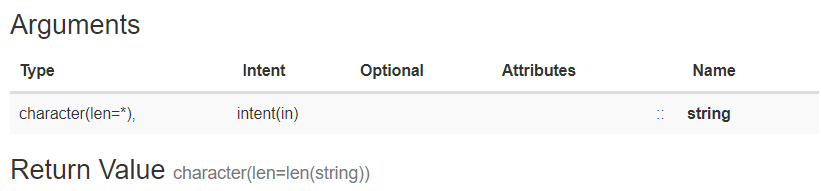
The input argument for the reverse() function is a string s which is the string to be reversed.
String is an intrinsic character type. String is an
Return value
The return value is an intrinsic character type of the same length as the input string.
Code
program demo_reverse
    use stdlib_ascii, only : reverse
    implicit none
    print'(a)', reverse("Hello, World!") ! returns "!dlroW ,olleH"
    print'(a)', reverse("hello") ! returns "olleh"
    print'(a)', reverse("world") ! returns "dlrow"
    print'(a)', reverse("Educative") ! returns "evitacudE"
    print'(a)', reverse("Fortran") ! returns "nartroF"
    print'(a)', reverse("edpresso") ! returns "osserpde"
end program demo_reverse
Output
!dlrow, olleH

olleh

dlrow

evitacudE

osserpde
In the example above, we invoke the reverse() function for a series of strings. The output can be compared with the original strings to identify that the original strings have been reversed.
Source code
The code below shows the internal working of the reverse(string) function in Fortran.
    pure function reverse(string) result(reverse_string)
        character(len=*), intent(in) :: string
        character(len=len(string)) :: reverse_string
        integer :: i, n

        n = len(string)
        do i = 1, n
            reverse_string(n-i+1:n-i+1) = string(i:i)
        end do

    end function reverse
Variables
It has the following variables:

Explanation
The code above has a simple working. The length of the string is stored in the variable n. A loop runs from i, initially set to 1, to n. For each iteration of the loop, the character at the index of the input string is placed on the index of the reversed string.