Project Euler 44: Pentagonal numbers
Problem statement
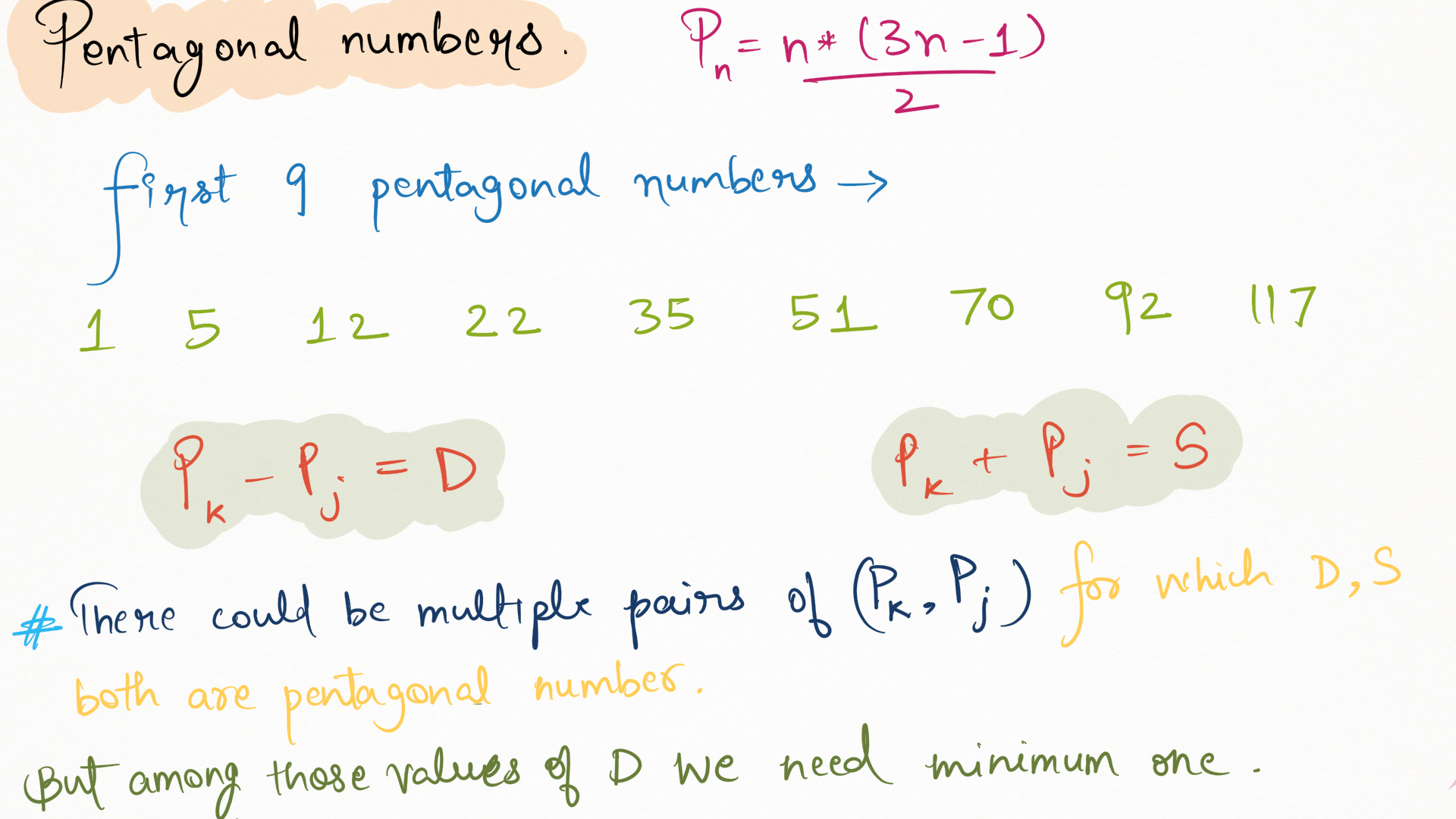
The nth term of the pentagonal sequence is defined as:
Pn = n*(3*n - 1)/2
Find a pair of two pentagonal numbers Pj and Pk, such that:
 Pk + Pj = S is a pentagonal
 number
 Pk - Pj = D is a pentagonal
 number and is minimum too.
What is the value of D?
Solution approach
We will run two loops:
- an outer loop over pentagonal sequence for the value of
P(k). - an inner loop over pentagonal sequence less than
P(k)forP(j).
Then, we will calculate and check if D and S are pentagonal.
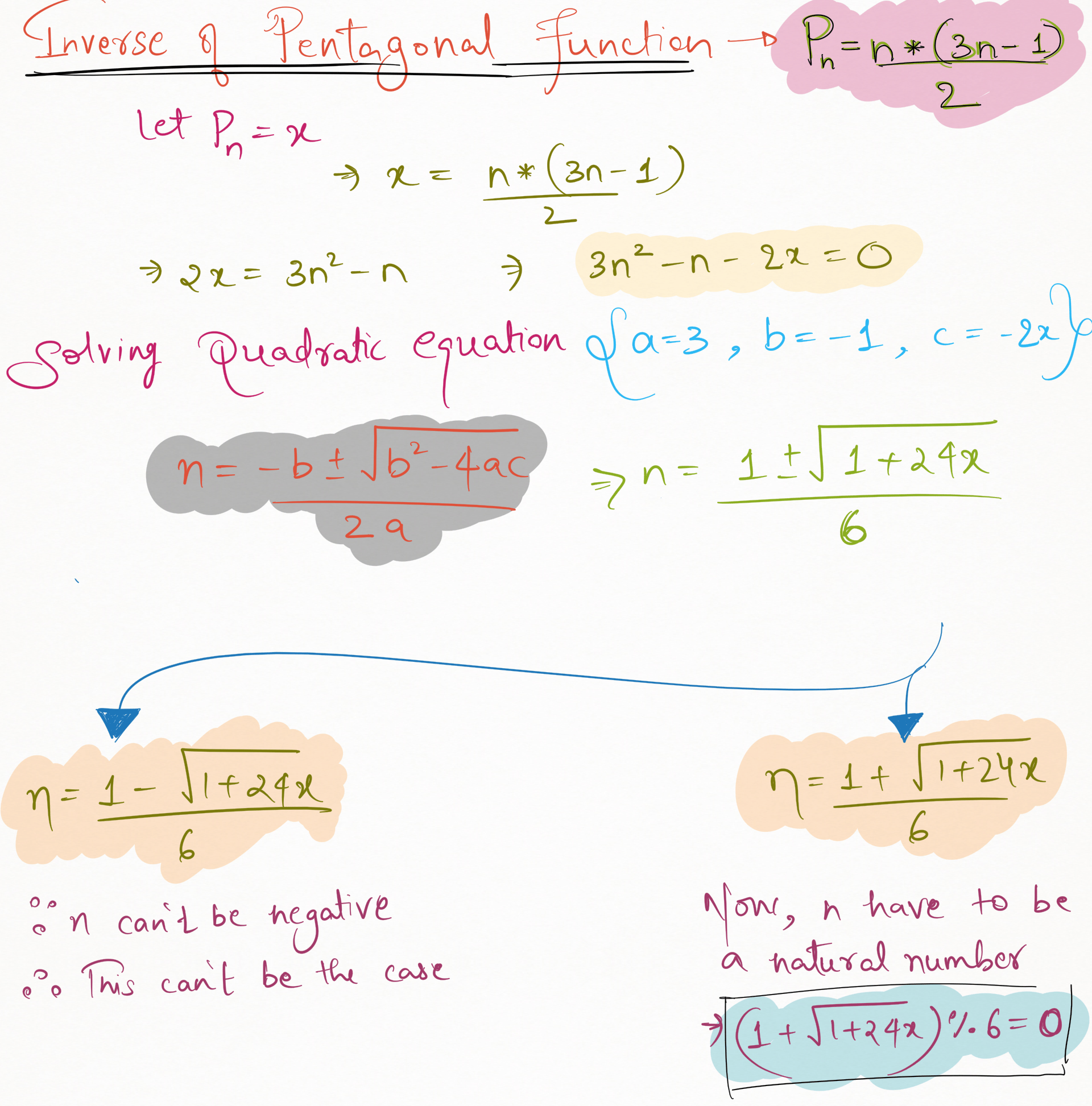
To check this, we will inverse the pentagonal function.
The moment we get a pair for which D and S are pentagonal, we’ll break the loop and return D.
This is because the first pentagonal D is also the minimum one.
Solution code
"""Coded by - Armaan Nougai"""from math import sqrtdef is_pentagonal(n): return (1+sqrt(1+24*n))%6==0i=0while True:i+=1k = i*(3*i-1)//2for v in range(1,i):j = v*(3*v-1)//2if is_pentagonal(k-j) and is_pentagonal(k+j) :print(k-j)breakelse:continuebreak
A question to address
Why is the first value of
D(i.e., 5482660) the minimum possible value ofD?
On analyzing the pentagonal sequence:
1. P(2)-P(1) = 4
2. P(3)-P(2) = 7
3. P(4)-P(3) = 10
Generalizing:
P(n)-P(n-1) < P(n+1)-P(n) < P(n+2)-P(n+1) ...
This means the difference between adjacent terms is increasing.
And also, for the nth term, the minimum D, even without the condition, will be:
P(n)-P(n-1)
Now, after getting the first value of D, we will continue the search for the lesser value of D until we find an adjacent pair that satisfies the condition and whose D is greater than the first value of D.
This is because, after this point, the D of every pair will be greater than the first value of D.