What are data types in Redis?
Remote Directory Server, otherwise referred to as Redis, is an open-source, fast, key-value, and in-memory data store used as a database. Redis provides a large variety of data structures for the user’s needs.
The most important feature of Redis is its low latency and high rate of data access, which is achieved because all Redis data resides in memory.
Data types in Redis
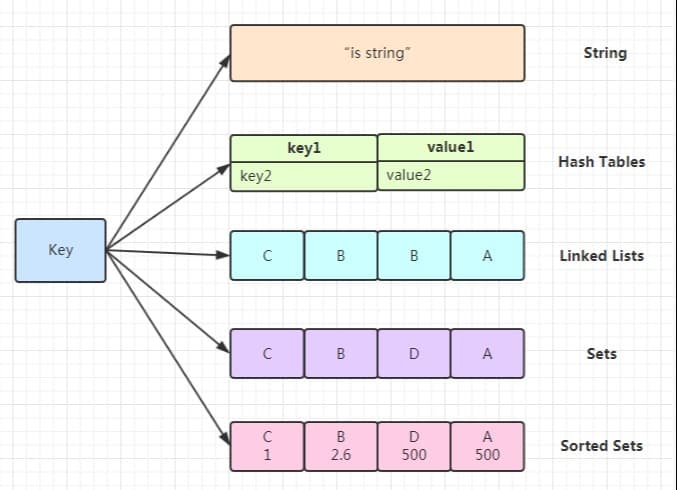
There are five data types in Redis.
1. Strings
Strings are the most basic kind of Redis data type that is considered to be binary-safe. This means they can contain any kind of data, e.g., an image in JPEG format. They can hold values up to a maximum of 512MB in size.
You can use strings in Redis for the following:
- To append strings with the
APPENDcommand. - Use of the
SETRANGEandGETRANGEcommands to randomly access vectors. - Encode a lot of data in little space.
- Use the
INCRfamily commands as an atomic counter.
2. Lists
These are simply lists of strings that are sorted by insertion order. New elements can be added to a Redis list by pushing the new elements on the left or right of the list.
You can use the LPUSH and RPUSH commands, respectively. A new list is created if any of these operations are carried out against an empty key.
Lists in Redis can be used for the following:
- To create a list that can never exceed a given number of elements by using
LPUSHtogether withLTRIM. Listssupport several commands, including blocking commands such asBLPOP.
3. Sets
These are unordered collections of Strings. Sets can be used to add, remove, and test for the existence of members, regardless of the number of elements contained inside the Set.
Adding the same element multiple times in sets will result in a set having a single copy of the element. Redis sets have the desirable property of not allowing members to be repeated.
You can use Redis sets for the following:
- Support several server-side commands to compute
setsand carry out operations such as intersections, unions, and differences ofsets. - Extract elements at random with the
SPOPcommand.
4. Hashes
Hashes are the most important data type to represent objects. They are maps between string values and fields.
A hash with a few fields is stored in a way that takes very little space, so millions of objects can be stored in a small Redis instance.
5. Sorted sets
Sorted sets are similar to sets in Redis. They are a non-repeating collection of strings. Individual members of a sorted set are given a score that allows the sorted set to be ordered from the smallest to the greatest score. Even though sorted sets are unique, scores may be repeated.
Sorted sets are the most advanced Redis data types. You can add, remove, and update elements in a time proportional to the logarithm of the number of elements.