What are log-concave functions?
Functions tend to be logarithmically concave if they follow a particular set of rules and conditions. In this Answer, we'll understand what constitutes such functions and examples that can elaborate the log-concave functions in a much simpler way.
Logarithmically concave functions
A function is log-concave if
Properties and identities
The properties of concave functions are listed as follows:
- Log-concave functions are also
quasi-convex. Identity 1 - Twice differentiable functions with a convex domain should satisfy the following condition:
For a single variable, the condition can be defined as follows:
- All concave functions with a positive domain are log-concave. However, a function that might not be concave in its derivative form may end up not being log-concave due to a violation of the conditions.
- The product of log-concave functions is always log-concave.
- The sum of log-concave functions may not be log-concave.
- If the function
that casts to is log-concave, then the following equation is also log-concave:
Now that we know about the properties of log-concave functions in detail, let's draw the graph of a log-concave function and check if it fulfills the conditions.
Examples
A few examples of log-concave functions are listed as follows:
is log-convex for , but log-concave for - Many probability densities are log-concave such as Laplace:
- Uni variate parametric families are log-concave such as:
- The cumulative Gaussian distribution is log-concave:
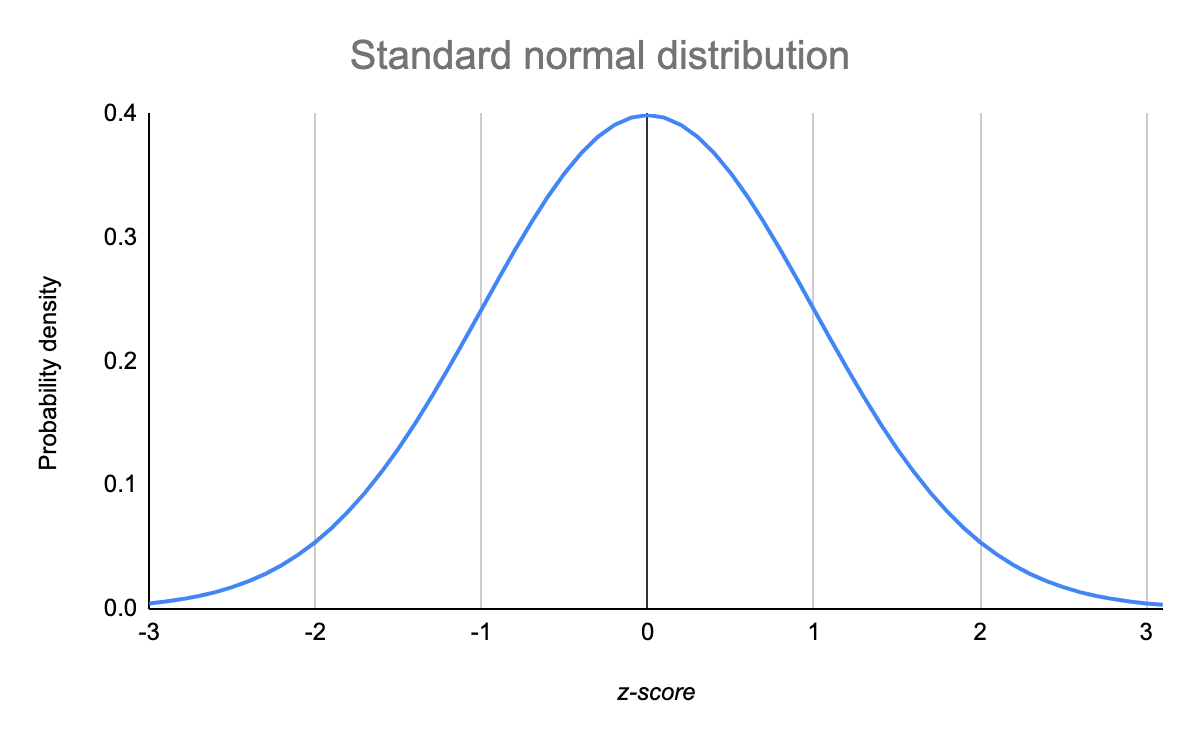
The Gaussian distribution (Reference: Scribbr)
- If
is compact and convex, then is a log-concave density.
Free Resources
Copyright ©2026 Educative, Inc. All rights reserved