What is Artifact Management in DevOps?
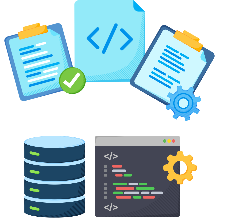
In software development, an artifact refers to any output or deliverable produced during the development process. It can be any file or set of files used, generated, or modified while creating a software application. Artifacts can take various forms, including:
- Source code
- Compiled code
- Libraries and cependencies
- Configuration ciles
- Documentation
- Executable ciles
- Database schemas and scripts

Artifact management
Artifact management in DevOps refers to handling and organizing the various software artifacts produced during the software development life cycle. These artifacts can include compiled code, libraries, documentation, and any other files or assets that are part of a software project.
Key aspects of artifact management in DevOps include:
Repository management
Versioning
Dependency management
Security and access control
Artifact life cycle management
Caching and proxying
Integration with CI/CD pipelines
Auditing and logging
Retention policies
Some of these key aspects are explained below
Repository management
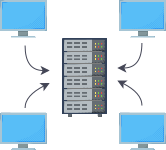
This involves maintaining a centralized repository where all artifacts are stored. This can be a local repository within an organization’s network or a cloud-based one. Popular tools for this purpose include Nexus, Artifactory, and AWS S3.



Versioning
Each artifact must be uniquely identified and versioned. This ensures that developers can retrieve specific versions of an artifact, which is crucial for reproducibility and traceability.
Dependency management
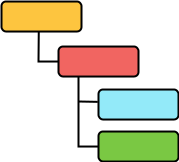
The artifact management system often deals with managing dependencies. It ensures that when a specific version of a software component is requested, it can also fetch any dependent artifacts that are needed.



Security and access control
It’s important to have proper access control mechanisms in place to ensure that only authorized personnel can upload, download, or modify artifacts. Additionally, the system should have features to scan artifacts for security vulnerabilities.
Artifact life cycle management
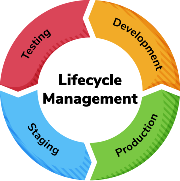
This involves defining the stages an artifact goes through, from initial development through to testing, staging, and ultimately production deployment. This can be automated, so artifacts move through these stages seamlessly.


Caching and proxying
Many systems implement caching and proxying to improve the performance of artifact retrieval. This is particularly important for remote repositories where internet connectivity might be a bottleneck.
Artifact management ensures that software development processes are efficient, reproducible, and secure. It helps teams keep track of dependencies, maintain version control, and confidently deploy software. It also aids in troubleshooting, providing a central location to find and analyze a software application’s components.
Free Resources