What is Boyce-Codd normal form (BCNF)?
Normal forms
The process of normalization refers to the reduction of redundancy from a set of relations. In database tables, we can use normal forms to carry out this process. The four main normal forms are:
- First normal form (1NF)
- Second normal form (2NF)
- Third normal form (3NF)
- Boyce–Codd normal form (BCNF)
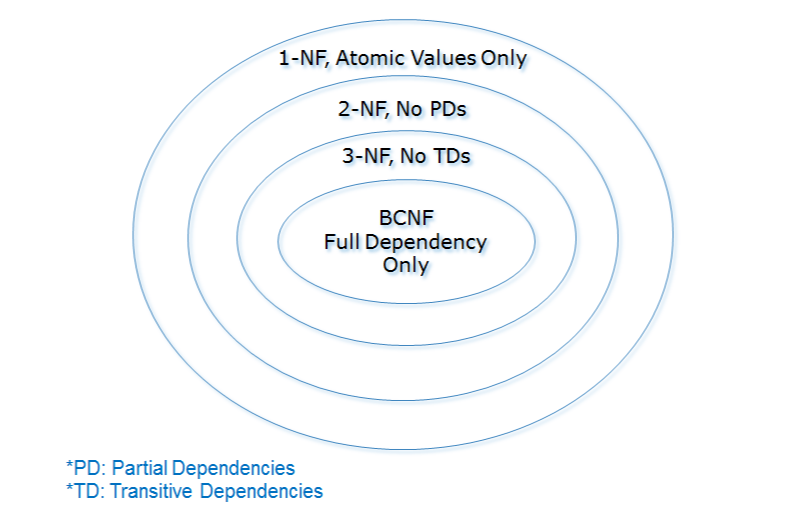
As the figure below shows, these normal forms build upon one another progressively. In this shot, we will focus on the Boyce-Codd normal form.
BCNF
For a relation to be in BCNF, it needs to satisfy the following conditions:
- It needs to be in third normal form.
- For every functional dependency X -> A, X should be a
superkey. a single column or set of columns which uniquely identify a row
Example
| A | B | C |
|---|---|---|
| A1 | B1 | C1 |
| A1 | B2 | C2 |
| A2 | B1 | C1 |
| A3 | B3 | C3 |
In the above relation, AB is the key. However, there is a functional dependency, as follows:
C -> B
The relation is in the first three normal forms because:
- All column values are atomic and have the same data type.
- There is no partial dependency.
- There is no transitive dependency.
However, the table is not in BCNF because in the dependency given above, C is not a superkey.
To achieve BCNF, we will have to remove the given dependency by splitting the table into two, as follows:
| A | B |
|---|---|
| A1 | B1 |
| A1 | B2 |
| A2 | B1 |
| A3 | B3 |
| C | B |
|---|---|
| C1 | B1 |
| C2 | B2 |
| C3 | B3 |
The first table has AB as the key. The second table has C as the key. There are no dependencies X->A where X is not a superkey. Hence, the relation is now in BCNF.
An algorithm to convert any relation to BCNF is given below.
- R = { R0 }
- While there is a relation in R which is not in BCNF:
2.1. Choose a relation in R which is not in BCNF
2.2. Find a dependency X->Y which is not in BCNF
2.3. Decompose the relation into two relations as R1 = X+ and R2 = [ X U A ], where A is the attributes not in X+