What is rapid application development (RAD)?
The rapid application development (RAD) model is based on prototyping and iterative development with no specific planning involved in writing the software. In early times, the waterfall model was the primary choice for developers. According to software development, a speedy approach is better than a rigid one. We can say that RAD is an adoption of the waterfall model.
What is RAD?
Rapid application development (RAD) is an agile methodology widely used in software development. RAD approach focuses more on the development stage rather than the planning stage, which allows stakeholders to see the process and progress and resolve issues at an early stage. Unlike the waterfall approach, stakeholders don't see a working build until several months have passed, which eventually complicates the whole process as it becomes difficult to add new requirements at that stage.
RAD phases
A rapid application development cycle consists of four steps:
Define project requirements
Prototype
Incorporate feedback
Finalize product
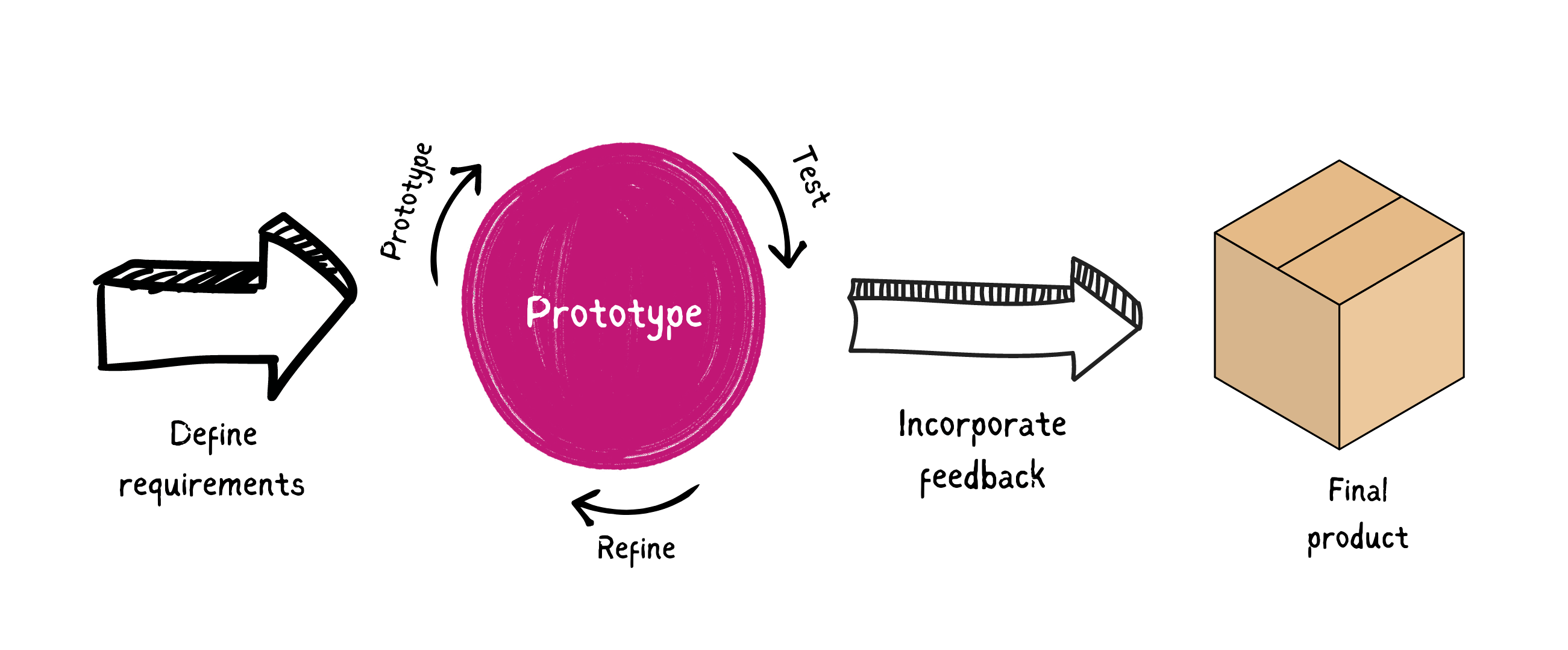
Define project requirements
In this phase, the stakeholders define their initial requirements. All project stakeholders, including developers, clients (software users), and team members, get together and set goals and highlight potential issues that could arise when developing. This also includes the timeline of the project deliverables and a brief budget. Although this phase isn't focused on too much compared to the prototyping phase, it still plays a critical role in avoiding miscommunication and financial loss.
Prototype
After the initial requirements are set, the development team builds the prototypes. Both developers and designers work collaboratively to produce a working build to show to the client. This is what differentiates RAD from other traditional methods. The project is developed in various iterations where the client tests each iteration and gives feedback to the development team if any improvements are needed. This enables the final product to be more efficient and less error-prone.
Incorporate feedback
In this phase, all the testing is done to convert the prototypes into an actual working model. Since the previous stage already included testing after every iterative design phase, this step takes less time as all the issues are already addressed by the client and fixed by the developers. The development team works together to ensure that the working model satisfies the client and meets all the requirements. The client can still ask for changes in the model. It either goes back to the prototyping phase or the last phase, implementation.
Finalize product
This is the last phase where the product is out for launch. The team hands over the documentation and the final product to the client after thoroughly testing the product in a live production environment.
Pros and cons of using RAD
RAD is an excellent choice for small projects but is not a solution for everything. Here are a few pros and cons of using RAD:
Pros
Flexibility: RAD allows us to break down our project into sub-projects where each component is tested, and the changes that the client wants are made within that piece. This also reduces the overall risk of the project.
Constant user feedback: This increases the overall efficiency and quality of the product. The team receives critical feedback at the right time, ensuring that the project is delivered correctly.
Increased productivity: RAD is suitable for smaller projects which increases the productivity of the team members because of the constant communication to complete the project.
Cons
Require highly skilled developers: Every team member must have the adequate technical expertise to complete the project. If one team member is lower than the others, it can slow down the whole process.
Not suitable for larger teams: RAD requires constant communication between team members, which can be an issue with large-scale projects requiring a larger team.
When should we use RAD?
RAD is ideal when we want to build our project quickly, and we need to satisfy our clients. RAD allows us to create and modularize our system in two to three months. This also reduces the risk of delivering a project that does not meet the client's requirements and can mitigate the cost and schedule risk. RAD is not preferred when the technical risk of the project is high.
Free Resources