What is the Erfc function in golang?
The Erfc function
The Go programming language uses the Erfc function to find the complementary error function of a certain decimal number.
To use this function, you must import the math package in your file and access the Erfc function within it using the . notation (math.Erfc). Here, Erfc is the actual function, while math is the Go package that stores the definition of this function.
The complementary error function
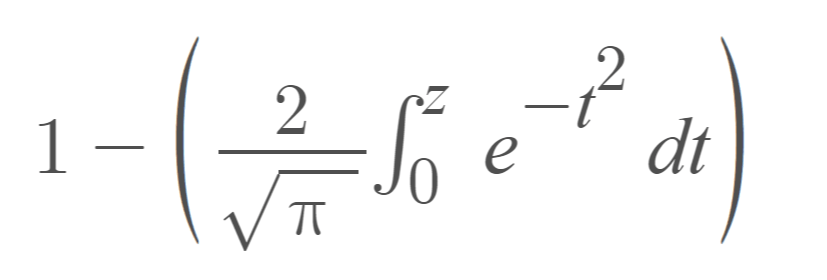
The complementary error function is a sigmoid function used in probability, statistics, and partial differential equations. It equals the error function subtracted from 1 (1 - erf(x)). It is represented using erfc(x), and the following formula defines it:
Function definition
The definition of the Erfc function inside the math package is:
Parameters
Erfc function takes a single argument of type float64. This argument represents the decimal number whose complementary error function you want to find.
Return value
The Erfc function returns a single value of type float64. This value represents the complementary error function for a particular input argument.
Following are two types of return values only used by the function under certain circumstances:
-
NAN: Not a number orNANis returned in all cases where the input argument is of undefined value. -
0: TheErfcfunction returns 0 if the input argument has a value equalling positive infinity. -
2: TheErfcfunction returns 2 if the input argument has a value equalling negative infinity.
Giving an empty argument or an argument that is not a numeric value results in an error.
Examples
Following is a simple example where we find out the complementary error function of a positive decimal value:
package mainimport ("fmt""math")func main() {x := 0.8y := math.Erfc(x)fmt.Print("The complementary error function of ", x, " is ", y)}
The following example shows how the Erfc function deals with arguments of infinite value:
package mainimport ("fmt""math")func main() {zero := 0.0// -1/zeoro is a negatively infinite valuey := math.Erfc(-1/zero)fmt.Print("The complementary error function of -Inf is ", y)fmt.Print("\n")// 1/zeoro is a positively infinite valuex := math.Erfc(1/zero)fmt.Print("The complementary error function of +Inf is ", x)}
Free Resources