What is the salt keyword in Solidity?
In cryptography, a salt is a piece of randomness introduced into a transaction to enhance security. Specifically, a salt is employed in Ethereum and Solidity when generating unique contract addresses through a hashing algorithm.
Cryptography generates a secret code for each transaction by applying a hashing algorithm. The transaction serves as an input to the hashing function, which, in turn, contributes to the derivation of a unique value—often referred to as a hash or digest. This unique value determines the contract address in contract deployment on a blockchain like Ethereum.
Let’s explore the intricacies of using the salt keyword and its application.
Application of salt keyword
The use of salt in cryptography serves the following two primary purposes:
Security enhancement: Adding the salt keyword in the transaction helps generate a secret code that is hard to determine/decipher, which makes it more challenging for attackers to guess or crack the secret code through cryptographic attacks.
Predictable contract address: Every time a contract gets deployed on the Ethereum blockchain, it is given an address. Usually, the algorithm calculates this address by combining the contract’s creator’s address with the creator’s nonce (the number of transactions sent from that address). The problem with this new contract’s address may be unpredictable, making some interactions with the contract challenging. Solidity addresses this case by including a deterministic value in the address computation through the
saltkeyword, a 32-byte keyword, hence generating deterministic addresses.
Address calculation with salt
Generating this new contract’s address uses a different technique if the option salt (a 32-byte value) is specified. It will calculate the address using the formed contract’s creation bytecode, the salt value provided, the address of the contract that is constructing it, and the constructor’s argument.
Using the unique salt value while deploying a contract on the blockchain, we can easily predict the resultant address. This has applications in establishing contracts that interact in specified ways with one another or generating a group of contracts with predictable addresses for testing purposes.
Consequently, the counter or “nonce” is not utilized to provide more flexibility in contract creation. This design choice enables the derivation of the new contract’s address before its creation. Additionally, this derived address remains reliable even if the creating contract generates other contracts in the interim.
Example
Here’s an example of how to use the salt keyword in Solidity. In this example, we’ll create a contract, CContract, from an existing contract, DContract. While creating CContract, we’ll compute its predicted address, compare it with its actual address, and see if they both match.
// SPDX-License-Identifier: GPL-3.0pragma solidity >=0.7.0 <0.9.0;contract DContract {uint public value;constructor(uint _value) {value = _value;}}contract CContract {function createDerivedContract(bytes32 salt, uint arg) public {// Predicting the addressaddress predictedAddress = address(uint160(uint(keccak256(abi.encodePacked(bytes1(0xff),address(this),salt,keccak256(abi.encodePacked(type(DContract).creationCode,abi.encode(arg))))))));// Creating a new instance of DContract with the specified salt and argumentDContract d = new DContract{salt: salt}(arg);// Verifying the deployed address matches the predicted addressrequire(address(d) == predictedAddress, "Address Mismatch");}}
Explanation
Line 2: Specify the version of the Solidity compiler that should be used to compile the smart contract code.
>=0.7.0indicates that the code is expected to be compatible with Solidity version 0.7.0 or any later version.<0.9.0indicates that the code is not guaranteed to be compatible with Solidity version 0.9.0 or any later version.
Lines 4–10: The
DContractcontract is defined, which represents a contract with a single state variablevalueof typeuint. This variable will store the value passed to the constructor during contract deployment. It will be publicly accessible, meaning other contracts or users can read its value.Lines 12–31: The
CContractcontract is defined. It contains thecreateDerivedContractfunction, which allows creating a new instance of theDContractcontract with a provided salt and argument. This function is marked aspublic, meaning it can be invoked from outside the contract.Line 15: The
predictedAddressvariable is declared to store the predicted address of the new instance ofDContract. It represents the expected address of the contract instance created with the given salt and argument.Lines 15–23: The
predictedAddressis calculated using a combination of hashing and encoding operations. It includes thesalt, which helps generate a unique address, the current contract’s address (address(this)), the Keccak256 hash A cryptographic function that takes in any amount of inputs and returns a unique 32 byte hash. DContract(which represents the contract’s bytecode), and the encodedargvalue (which will be passed to the constructor ofDContract). The complicated expression ofpredictedAddressjust tells us how the address can be precomputed. It is just there for illustration. We actually only neednew DContract{salt: salt}(arg).Line 26: The
newkeyword is used to create a new instance of theDContractcontract namedd. Thesaltis passed as an argument to the constructor, along with theargvalue. This deployment step triggers the execution of the constructor function withinDContractand creates a new instance ofDContracton the blockchain.Line 29: The
requirestatement is used to ensure that the address of the deployeddcontract matches the predicted address. It verifies that the actual address of the deployed contract is the same as the expectedpredictedAddress. If the addresses do not match, the transaction will revert, indicating a mismatch between the predicted and actual addresses. This provides a way to verify the integrity of the contract creation process.
Note: Solidity compiler returns a binary output. For better interactivity, refer to the Remix IDE and paste the code above in a
.solfile. After compilation and deploying the code on the blockchain, we’ll be able to see the successful deployment message similar to the one shown below:


Interacting with the deployed contract
Follow the steps below to test the expected behavior:
Deployment: Ensure that the contract has been successfully deployed on the Ethereum blockchain. Note the contract address provided during deployment.
Select the deployed contract: In Remix, navigate to the “Deployed Contracts” section.
Interact with
createDerivedContract:Select your deployed contract from the list.
Locate the
createDerivedContractfunction, which takes abytes32 saltand auint256 argas parameters.
Enter values: Enter desired values for
bytes32 saltanduint256 argin the input fields. For example:bytes32 salt:0x1234567890abcdef1234567890abcdef1234567890abcdef1234567890abcdefuint256 arg:42
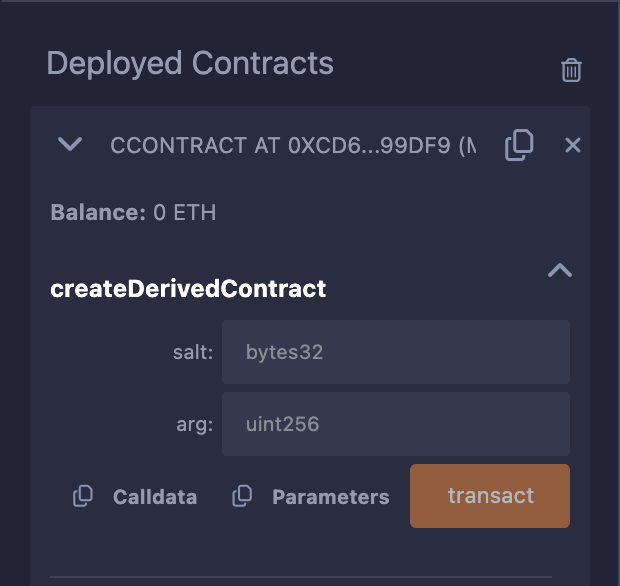
Execute the transaction: Click the “Transact” button to execute the transaction.
Check output: Monitor the Remix console for transaction details.
If the require statement in the contract is satisfied (predicted and actual addresses match), the transaction will be successful.

In case of errors or an address mismatch (try this by removing the salt keyword from the predictedAddress definition, redeploy, and interact with this new contract), we’ll see an “Address Mismatch” error message.

By following the steps above, we can test the createDerivedContract function with different salt and arg values to ensure the proper deployment and address prediction functionality of the contract.
Free Resources