Fine-Tuning BERT for Extractive Summarization
Explore how to fine-tune BERT models for extractive summarization by modifying input formats to capture sentence-level representations. Understand embedding layers and how to classify sentence importance for summary extraction using the BERTSUM approach.
Let's learn how to fine-tune the BERT model to perform text summarization. First, we will understand how to fine-tune BERT for extractive summarization, and then we will see how to fine-tune BERT for abstractive summarization.
Extractive summarization using BERT
To fine-tune the pre-trained BERT for the extractive summarization task, we slightly modify the input data format of the BERT model. Before looking into the modified input data format, let's first recall how we feed the input data to the BERT model.
Say we have two sentences: 'Paris is a beautiful city. I love Paris'. First, we tokenize the sentences, and we add a [CLS] token only at the beginning of the first sentence, and we add a [SEP] token at the end of every sentence. Before feeding the tokens to the BERT, we convert them into embedding using three embedding layers known as token embedding, segment embedding, and position embedding. We sum up all the embeddings together element-wise, and then we feed them as input to the BERT. The input data format of BERT is shown in the following figure:

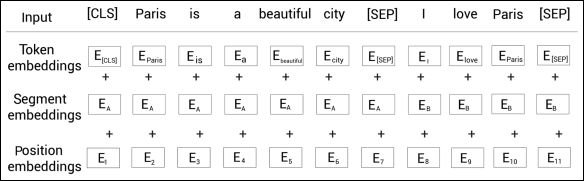
The BERT model takes this input and returns the representation of every token as output, as shown in the following figure:

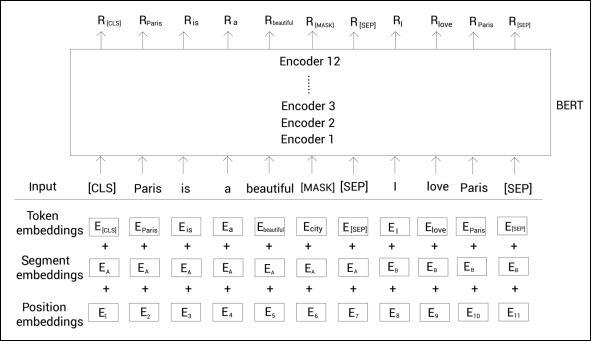
Now the question is, how can we use the BERT for the text summarization task? We know that the BERT model gives a representation of every token. But we don't need a representation of every token. Instead, we need a representation of every sentence.
Need for a representation of every sentence
We learned that in extractive summarization, we create a summary by just selecting only the important sentences. We know that a representation of a sentence will hold the meaning of the sentence. If we get a representation of every sentence, then based on the representation, we can decide whether the sentence is important or not. If it is important, then we will add it to the summary, else we will discard it. Thus, if we obtain the representation of every sentence using BERT, then we can feed the representation to the classifier, and the classifier will tell us whether the sentence is important or not.
Getting a representation of the sentence
Okay, how can we get the representation of a sentence? Can we use the representation of the [CLS] token as the representation of the sentence? Yes! But there is a small catch here. We learned that we add the [CLS] token only at the beginning of the first sentence, but in the text summarization task, we feed multiple sentences to the ...