@BeforeEach and @AfterEach Annotation
Explore how JUnit 5 creates a new test class instance for each test method and how the @BeforeEach and @AfterEach annotations run setup and teardown code around each test. Understand their role in organizing common test logic for cleaner, more maintainable unit tests.
We'll cover the following...
We'll cover the following...
@Test and Constructor
In Junit 5 for each test, a new instance of test class is created. So, for e.g. if a class has two @Test methods than two instances of test class will be created, one for each test. Thus, the constructor of the test class will be called as many times as there is the number of @Test methods. Let’s look at the demo:-
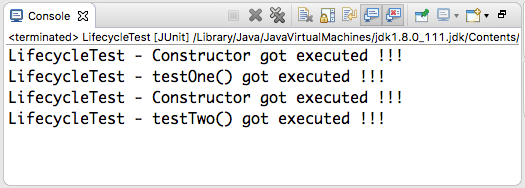
Output of the test
...