Embark on the SQL Adventures
Discover the foundational concepts of SQL and its role in managing complex data efficiently. Learn how businesses transition from spreadsheets to relational databases and get hands-on experience running your first SQL queries. This lesson prepares you to navigate databases and generate useful reports.
Exploring data horizons
Whether you’re delving into SQL due to business growth or simply eager to explore its territories, join us on this journey. Business expansions frequently prompt a shift from spreadsheets to relational databases, marking a crucial change in the management of complex data. This transition indicates a significant advancement in data management, moving from basic tools to a more sophisticated framework. It involves not only managing data but also decoding intricate information.
In this course, you’ll navigate through databases and SQL, using the given scenario as our guide to transverse a variety of engaging challenges.
The scenario: Strategic shift to relational databases
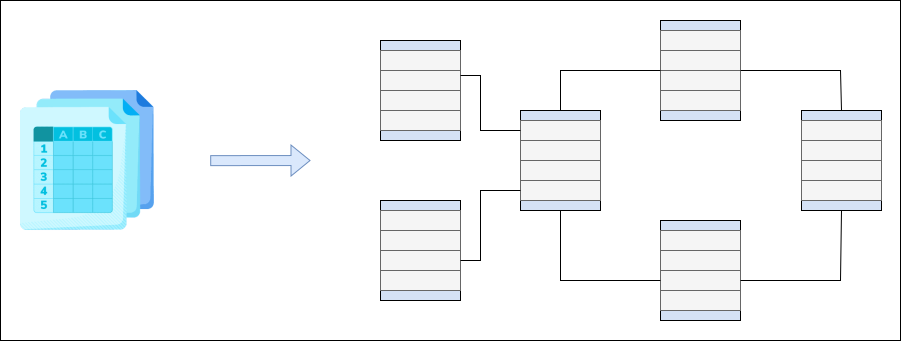
Imagine a small retail store that started from the ground up. Initially, they efficiently managed their product inventory, sales, and customer data using basic spreadsheets. However, as their product range grew and inventory increased, the spreadsheets that were once easy to handle became difficult to manage. The expanded spreadsheet posed a challenging task to handle. The increasing size and complexity of data made it slow to load and more likely to have mistakes. Doing advanced analysis and reporting became a difficult task.
Recognizing the need for a more robust solution, they made the strategic decision to migrate to relational databases. This shift marked a significant turning point, offering them a more scalable and efficient platform to handle their expanding product lines and sales data.

The role: Steering insights as the data navigator
Now, suppose you are hired to navigate these challenges. Your role involves generating reports that delve into various aspects of the business, such as product performance, inventory trends, and sales analysis.
Your first task is to go through their sales transaction data.
You have received the following representation of the data and the associated reports. You are required to generate these reports by writing SQL queries.
Examining the given dataset might not seem daunting for the current task. Nonetheless, it’s crucial to acknowledge that this dataset is merely a small subset of their database. A complete dataset would involve multiple tables and hundreds of thousands of records, therefore requiring more intricate tasks.
The need: Cultivating SQL proficiency as a vital skill set
For success in this journey, the primary objective is to master Structured Query Language, known as SQL (sometimes pronounced as “sequel”). Proficiency in SQL not only facilitates seamless navigation through databases but also empowers individuals to uncover crucial information concealed within these data repositories.
In simple words, SQL helps to make informed data-related decisions by offering better organization and analysis techniques.


Throughout this course, we'll gain the proficiency to compose SQL queries that generate the reports we have seen in the previous section.
A taste of SQL
To get a taste of what it takes to generate the above mentioned reports from the given dataset, take a good look at the following piece of code. Click on the “Run” button below when you’re ready.
Congratulations, you just ran your first SQL program.
Introducing personalised AI mentoring
What if we ask you to generate a report that selects the sales data where the product category is Electronics instead of Furniture. Can you think of the minimal change that is required in line 3 of the following code? You may click on “Show Solution” button to view the correct solution. Should you require assistance, our AI Mentor is here to provide personalised guidance.
Congratulations, you just wrote your first SQL program.
We’ve only seen a glimpse of SQL, but we'll systematically delve into SQL, exploring its concepts step by step starting with the next lesson. But can you answer the following questions first?
(Select all that apply.) What challenges did the small retail store face with their extensive spreadsheets? Multi-select
Slow loading and prone to errors
Inadequate support for maintaining data integrity
Inability to handle basic reporting
Efficient management of data
So far, so good. Let’s embark on this exciting journey.
Though a spreadsheet looks very similar to a database table, what distinguishes them from each other?