What are ord() and chr() functions in Python?
ord() function
The ord() function is a built-in function in Python that converts a specified character into an integer
Syntax:
ord(a)
Example: A string of length 1 returns an integer representing the Unicode code point of the character when an argument is a Unicode object or the byte’s value when the argument is an 8-bit string. So, if we take ord(‘a’) it returns the integer 97, and ord(‘€’) (Euro sign) returns 8364.
Note: If the length of a string is more than one, a TypeError will be raised.
print(ord('A'))print(ord('a'))print(ord('&'))
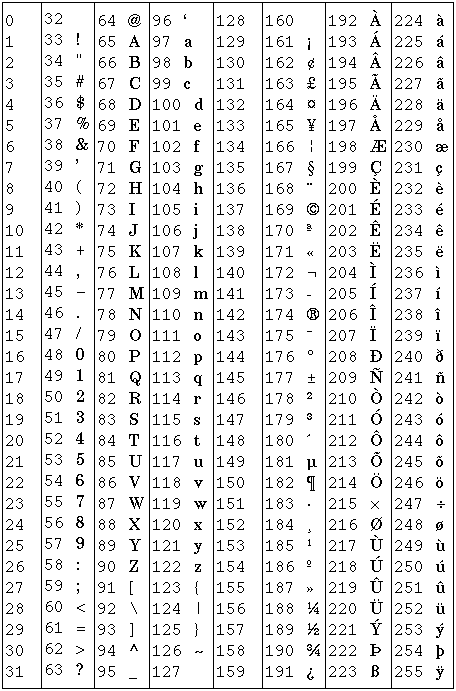
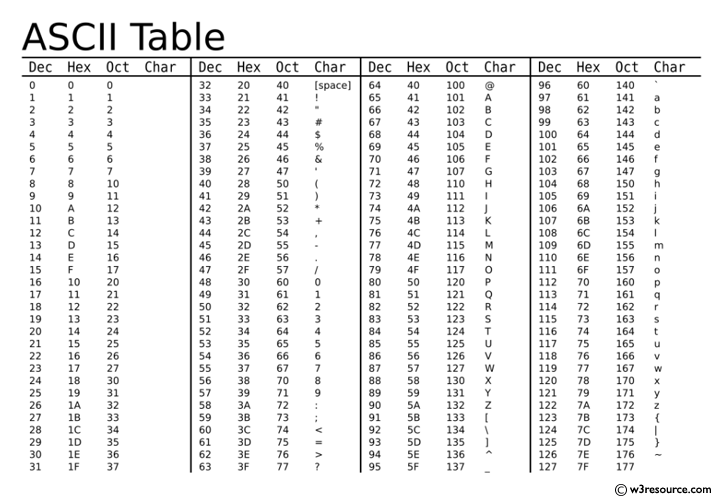
ASCII table
Below is an ASCII table, use this for reference.
chr() function
The chr() function is a built-in Python function that converts a specified integer value into a character.
Syntax:
String chr(n)
The valid range for n is 0 to 1,114,111.
The chr() function returns a string that represents a character whose Unicode code point value is n.
Note: If an integer is passed outside the range, the method returns a ValueError.
Example
print(chr(65))print(chr(36))print(chr(97))
Unicode character
Below is a Unicode character set table, use this for reference.