Types of AR Applications
Understand the two primary types of augmented reality applications: marker-based and markerless AR. Discover how marker-based AR uses target images to position objects, while markerless AR relies on device sensors and SLAM technology for placing virtual items in real-world settings. Learn about four types of markerless AR—location-based, projection-based, contour-based, and overlay AR—with examples like Pokémon GO and face filters to see how AR integrates digital content with physical environments.
We'll cover the following...
There are two main types of AR applications: marker-based and markerless. Markerless AR has the following four types:
- AR based on location
- AR based on projection
- AR based on contour
- AR overlay

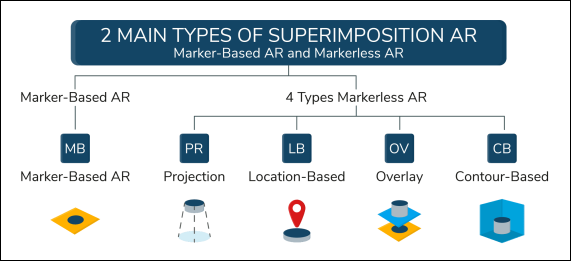
Different types of AR are used for different purposes. The following section discusses the application of each type.
Marker-based AR
AR applications that use markers rely on target images and patterns to position digital objects within a defined space.
These applications use marker patterns in the physical world to superimpose 3D digital objects onto them. In the initial stages of AR technology, markers were a crucial component of these applications. The technology comprises several components, including cameras, image capture, processing, tracking, and other elements. Nonetheless, it’s a simple and economical method to implement. Instagram and Snapchat filters and games are prominent examples of marker-based AR technology that has become ubiquitous in everyday life and social ...