Scaling on the cloud
Explore how to design and implement high availability solutions in cloud architecture by applying redundancy, monitoring, and failover techniques. Understand scaling strategies for compute, network, storage, and database services to ensure reliable and resilient cloud deployments across multiple availability domains.
We'll cover the following...
- Highly available (HA) architecture
- Redundancy
- Monitoring
- Failover
- Architecting high-availability solutions
- Compute high-availability design cloud infrastructure
- Network high availability design
- Load balancing high availability design
- FastConnect and VPN high availability design
- Network high availability design with FastConnect or Direct Connect
- FastConnect/Direct Connect
- Continuous testing of redundant paths
- Cloud Infrastructure Block Volume
- Cloud infrastructure Object Storage
- Cloud infrastructure file storage
- Cloud database high availability design
- Using 2-node RAC DB systems
- Automated CPU and Storage Scaling
- Conclusion
Highly available (HA) architecture
Introduction
This reference architecture provides best practices for planning, designing, and deploying high-availability (HA) solutions that can be applied to any cloud infrastructure service. A high-availability service or application is one designed for maximum potential uptime and accessibility. To design a high-availability architecture, three key elements should be considered
- Redundancy
- Monitoring
- Failover
Redundancy
Redundancy means that multiple components can perform the same task. The problem of a single point of failure is eliminated because redundant components can take over the task of a failed component.
Monitoring
Monitoring checks whether a component is working properly.
Failover
Failover is the process by which a secondary component becomes primary when a primary component fails. Although high availability can be achieved at many levels, including the application and cloud infrastructure levels.
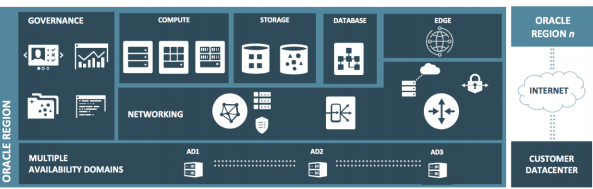
High-availability building blocks are, by region, a localized geographic area composed of several availability domains. An availability domain consists of one or more data centers within a region.
Availability zones/domains are isolated from each other, fault-tolerant, and very unlikely to fail simultaneously. Because availability domains do not share physical infrastructure, such as power or cooling, or the internal availability zone network, a failure that impacts one availability zone is unlikely to affect the others. All the availability zones/domains in a region are connected to each other by a low-latency, high-bandwidth network.
This predictable, encrypted interconnection between availability domains provides the building blocks for both high availability and disaster recovery. Note that cloud infrastructure resources are either region-specific, such as a virtual cloud network, or availability-domain-specific, such as a Compute instance.
When configuring your cloud services, if the services are specific to an availability domain, it is important to leverage multiple availability domains to ensure high availability and protect against resource failures.
For example, when you deploy a compute instance, it resides in one particular availability domain. If this instance is not redundantly deployed across availability domains, it will be impacted when its availability domain encounters issues.
Architecting high-availability solutions
This describes each cloud infrastructure layer and provides detailed best practices and design guidelines for architecting high availability solutions.
Compute high-availability design cloud infrastructure
Compute provides virtual machine (VM) instances, giving you the flexibility to deploy any size server you need. This gives you the performance, flexibility, and control to run your most demanding applications and workloads in the cloud. Elimination of a single point of failure. One key principle of designing high-availability solutions is to avoid a single point of failure. It is recommended to design your ...