Tools for Data Preprocessing and Model Development
Explore essential tools and libraries used for data preprocessing and model development in machine learning. Understand how these tools prepare data and support building models that solve real-world problems in AI.
We'll cover the following...
Machine learning is a robust field that converts raw data into usable information. The process of transformation takes place in two stages:
Data preprocessing
Model development
Let’s look at the tools and techniques used in these two important stages.
Data preprocessing
Data preprocessing is an important stage in the machine learning pipeline that transforms, cleans, and organizes raw data to make it useful for training machine learning models. This phase is important because the quality of the data we include in our models directly affects their performance.
Here’s a list of common tools for data preprocessing in machine learning:
Jupyter Notebook: This interactive computing environment facilitates code execution, data visualization, and exploration.
NumPy: This basic Python library for numerical computations is frequently used for array operations and data manipulation.
SQL: This language was developed for handling and querying structured data.

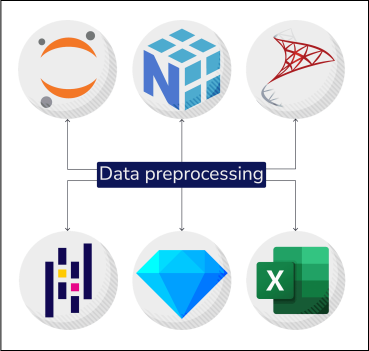
pandas: This versatile Python data manipulation library is suitable for data cleaning, modification, and analysis.
OpenRefine: This data exploration and cleaning tool includes data transformation and refining features.
Excel: This application for spreadsheets is frequently used for preliminary data exploration and simple data preprocessing tasks.
Model development
The creation and training of machine learning models to address specific issues or include data-driven predictions is known as model development. In machine learning, model development is the process of building, refining, and improving a mathematical or computational representation, called a model, by utilizing previous data to predict outcomes, categorize data, or extract patterns and insights. The ultimate goal of this process is to solve particular tasks or problems in the artificial intelligence domain.
Here’s a list of common machine learning model creation tools:
PyTorch: This open-source machine learning framework supports deep learning and neural networks.
TensorFlow: This is Google’s renowned open-source machine learning framework for multiple tasks related to machine learning and deep learning.
Jupyter Notebook: This computing environment is interactive and frequently used for testing and developing machine learning models.
AutoML tools: These are platforms for automated machine learning with the objective of speeding up and simplifying the creation of models.
LightGBM: This gradient boosting framework is well known for training models quickly and efficiently.


CatBoost: This high-performance, open-source gradient boosting library excels at supporting categorical features.
XGBoost: This optimized gradient boosting library is designed for high model performance and effectiveness.
Google Colab: This free online platform provides access to Jupyter Notebooks as well as GPU resources for model creation.
Azure Notebook: This Jupyter Notebook service runs machine learning models on the cloud.
scikit-learn: This is a Python machine learning library with a diverse set of tools and algorithms for model creation.
Note: Iterative procedures, such as data preprocessing and model building, are required to optimize the models and get the best potential results. The quality of data preprocessing, as well as the selection and training of relevant models, are critical for the success of a machine learning project.