Convex Sets and Functions
Explore the definitions and properties of convex sets and convex functions. Understand their mathematical characterization, importance in optimization, and how convexity ensures unique global solutions in machine learning problems.
Convex sets
A set
In other words, convex sets are sets such that a straight line connecting any two elements of the set lies inside the set.
Some properties of convex sets are given below:
The empty and the whole space are convex.
The intersection of any collection of convex sets is convex.
The union of two convex sets need not be convex.
A non-convex set is a set that is not convex. In other words, in a non-convex set, a straight line connecting two elements of the set doesn’t always lie inside the set. Sometimes, non-convex sets are also referred to as concave sets.
The figure below illustrates the difference between convex and non-convex sets visually:

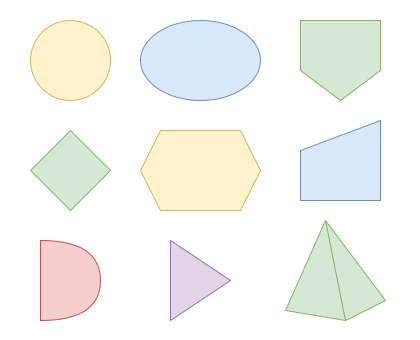
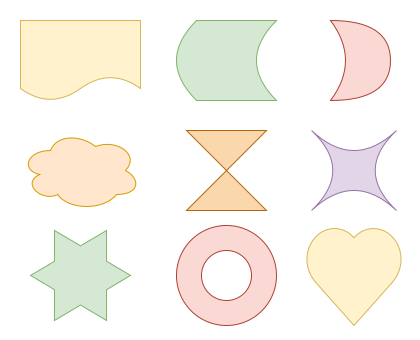
For example, if we draw a line between any two points inside a circle, we find that the entire line segment stays within the circle. This is why a circle is considered a part of the convex set. Similarly, if we draw a line between two points located in the lobes of a heart shape, we see that part of the line segment falls outside the heart shape. Therefore, a heart shape is not a part of the convex set. Similar explanations hold true for all the shapes in the sets in the figure above.
Convex functions
Convex functions are functions such that a straight line between any two points on the function always lies above the function. Mathematically, a function
A function is strictly convex if the following property holds:
To understand the relation between convex functions and convex sets, consider the set obtained by filling in a convex function. A convex function is a bowl-like structure, and after filling it with water, the resultant filled-in set is always a convex set.
Some common examples of convex functions are given below:
, where . , where . ...