Preparing for the Google FDE Role
A Forward Deployed Engineer (FDE) at Google turns customer requirements into production-ready systems. The role requires hands-on engineering, failure analysis, an understanding of operational constraints, and the ability to clarify ambiguous customer requirements. Start your preparation by assessing your current skills, setting a realistic practice schedule, and identifying areas that need improvement through focused exercises. Use structured practice sessions to evaluate your performance across four areas: coding, AI agent design, cloud infrastructure, and customer communication. Apply realistic engineering scenarios, measurable performance criteria, and feedback from each session to track your progress. Focus on demonstrating how your engineering decisions affect deployment reliability and customer requirements.
A Forward Deployed Engineer (FDE) works with customers to design, build, and deploy production systems within their existing environments. The role extends beyond building successful demos to delivering systems that customers can deploy, operate, maintain, and improve.
Assess your readiness for the role across four core skills:
Designing and building production systems.
Diagnosing failures and troubleshooting systems.
Evaluating operational constraints.
Clarifying ambiguous customer requirements.
Start by identifying which skills you can demonstrate through past work and which need further assessment. Use that assessment to allocate your preparation time based on the gaps you identify.
Beyond the demo
A model demonstration can establish the feasibility of a proposed solution. A production deployment must also handle real customer workloads, data access controls, operational constraints, and support responsibilities. FDEs help bridge this gap by turning validated prototypes into systems that customers can deploy and maintain.
The process starts with understanding customer requirements, defining success criteria and constraints, building and integrating a solution, validating it under realistic conditions, and establishing ongoing support and maintenance responsibilities. Validation may reveal incorrect assumptions about customer requirements or constraints, requiring the engineer to revisit the design.
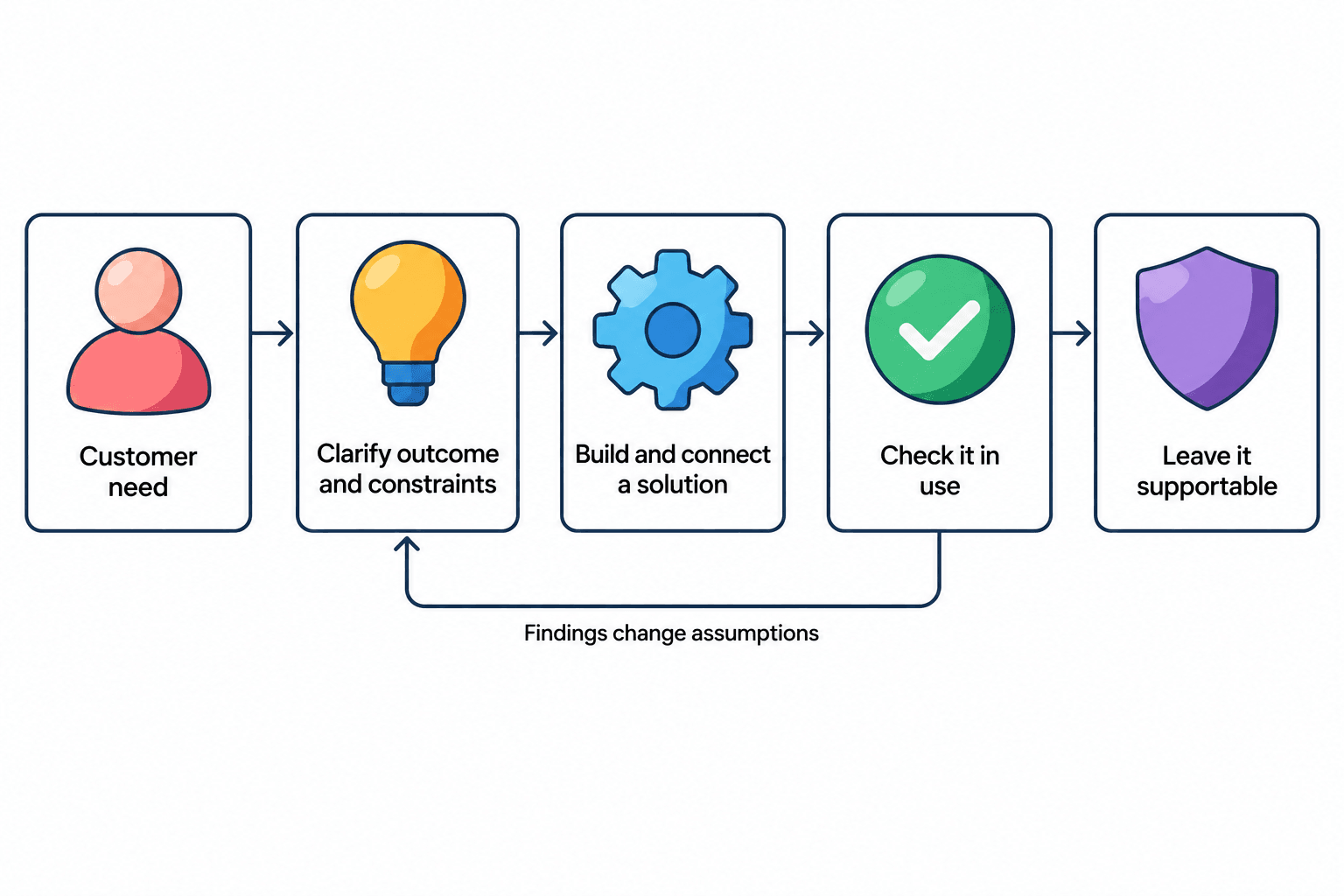
Suppose a support team wants an assistant that answers questions from internal guidance. The demo produces correct answers to five preselected questions. The team has not validated the assistant against representative queries, verified access controls, or assigned responsibility for updating answers when the guidance changes.
Ask "What are the most common support queries?" and request anonymized examples to assess whether the demo reflects actual usage. Ask "Which documents can each user access?" and review the current access-control policy to determine whether the assistant can enforce those permissions. Ask who approves content corrections and review the existing maintenance process to determine how the assistant will keep its answers accurate as guidance changes.
Each question identifies evidence needed to evaluate deployment readiness. Selecting a model before resolving these questions leaves critical deployment requirements undefined. A more capable model cannot replace access-control enforcement or establish responsibility for maintaining outdated guidance.
Four capability phases
Each phase builds on the skills developed in the previous one. Role defines the FDE's responsibilities and what the interview process evaluates. Toolkit covers integrating the Gemini stack with enterprise data sources and cloud infrastructure. Judgment focuses on system architecture, evaluation, security, and debugging trade-offs. Performance tests these skills through practical exercises under realistic interview conditions.
The Performance phase includes three standalone customer scenario exercises. Each exercise follows five stages: case review, discovery, system design, Googleyness assessment, and debrief. The scenarios progress from a data-intensive single-agent system to a regulated multi-agent system, followed by a multimodal system with data sovereignty requirements. Each scenario represents a different customer, so you must reassess requirements and constraints rather than carry assumptions forward from earlier exercises.
These checkpoints distinguish technical knowledge from applied engineering judgment. Understanding individual components helps you justify architectural decisions, but does not demonstrate your ability to make those decisions in a complete system. Even a technically valid design requires practice to assess whether you can explain and defend it within interview time limits.
Your starting point
This course is designed for software and ML engineers with at least three years of experience who are preparing for Google's FDE interviews. You should be comfortable writing Python and understand basic cloud concepts. Prior experience with Google Cloud, Gemini, or AI agent frameworks is not required.
You should be able to write Python functions, use common data structures, and explain basic application deployment workflows. Later lessons introduce the relevant Google Cloud services, so prior familiarity is unnecessary.
Your previous engineering and deployment experience can provide examples for interview preparation. Relevant experience includes building services, maintaining pipelines, debugging ML workflows, or supporting application migrations. You are not expected to have deployed every type of system covered in this course. Start by identifying examples from your past work that demonstrate relevant skills and areas where you need additional practice.
Inventory four domains
An evidence inventory records what supports an ability, what remains unproven, and what small task would reduce that uncertainty. Use four broad domains:
Coding: Can you implement, test, explain, and debug Python under a constraint?
Agentic design: Can you reason about a model-assisted workflow, how it could fail, and how you would check its results?
Cloud: Can you explain how an application runs, accesses data, and is operated?
Customer skills: Can you describe clarifying a need, resolving a tradeoff, and checking the result with stakeholders?
These preparation domains align with different parts of Google's FDE interview process. Coding focuses on programming assessments; agentic design covers AI-assisted coding and system architecture; cloud knowledge supports deployment and infrastructure decisions; and customer-facing skills help with requirements discovery and Googleyness discussions.
These categories and checkpoints are intended for practice. They do not represent Google's official hiring criteria or guarantee interview success.
For each domain, document a specific example, your contribution, the resulting outcome or artifact, any evidence gaps, and one focused exercise to assess your skills. If you lack supporting evidence, record "Not yet demonstrated" rather than assuming proficiency. A skill you have not tested remains unverified. Missing evidence does not establish whether you can perform the task.
Consider an engineer preparing for four weeks, with eight hours available each week. Their initial skills assessment shows:
Coding: They shipped a Python service and wrote its tests. The implementation and tests support production coding experience. There is no recent evidence of solving an unfamiliar problem while explaining decisions under time pressure. Next diagnostic: A timed Python attempt with tests and a complexity explanation.
Agentic design: They built an internal model demo. The demo shows that they connected a model to an application, but it used selected examples and had no representative evaluation. Next diagnostic: Sketch one workflow, identify a failure, and propose examples that would expose it.
Cloud: They deployed a basic cloud application. They can identify where it runs but cannot clearly explain which identity accesses its data or how access is restricted. Next diagnostic: Draw the application-to-data path and explain the access boundary aloud.
Customer skills: They participated in a customer migration. The project happened, but their account does not isolate their own decision or a measured result. Next diagnostic: Reconstruct one decision using permitted project records and identify what outcome evidence exists.
The entries contain different kinds of uncertainty. Before looking at the allocation, decide which ones justify substantial new practice and which first need a targeted check or clearer explanation.
Choose two priorities
Agentic design and cloud are the provisional priorities. Both have substantive evidence gaps: The engineer has not shown how they would evaluate the model workflow or explain the deployed application’s access boundary.
Coding has stronger implementation evidence, but timed performance remains untested. That calls for an early diagnostic. Waiting until the final week would leave too little time to respond if the attempt exposes a problem.
Start by reviewing the customer migration project to identify evidence of your contribution and its outcome. You may already have relevant experience, but you need to clarify your responsibilities and document the results. Building another project would consume preparation time without addressing the lack of evidence about your previous work.
Use each identified gap to choose the next practice task:
Production Python experience, untested under time limits: Complete a timed coding exercise to establish your baseline.
Working demo, no evaluation results: Practise designing evaluation cases and measuring system performance.
Cloud deployment experience, unclear access controls: Practise tracing authentication, authorization, and permissions through the system.
Customer project, unclear individual contribution: Document your decisions, responsibilities, and outcomes using available project evidence.
Dividing the 32-hour preparation budget equally across four domains may seem reasonable, but it ignores differences in demonstrated skill and evidence gaps. This would allocate as much time to documenting an existing migration project as to evaluating an AI workflow that has not been tested. An evenly distributed schedule may also delay the first timed coding assessment until the final week.
Allocate preparation time based on the identified skill gaps and the evidence needed to assess them. For this learner, allocate 8 hours to coding, 10 to AI agent design, 6 to cloud infrastructure, 4 to documenting customer project experience, and 4 to integrated practice and review. This totals 32 hours across four weeks, at eight hours per week. Adjust these priorities after reviewing the target job description and completing the remaining assessments in this chapter.
Spend the 32 hours
These are practice allocations around the course’s approved sequence. They neither replace the lesson order nor imply that all 48 lessons can be completed deeply in 32 hours. Every block should leave an inspectable output.
Week 1
For Week 1, allocate 2 hours to coding, 3 to system design, 2 to cloud infrastructure, and 1 to documenting customer project experience. This totals 8 hours.
Coding, 2 hours: Attempt an unfamiliar Python problem within 45 minutes, then review your solution and fix any issues. Preserve the original timed submission separately from subsequent revisions. Deliverables: The original submission, executable tests, and an explanation of time and space complexity.
Design, 3 hours: Diagram a model-assisted workflow and trace a request through its main components. Deliverables: A request flow, one plausible failure scenario, and test cases designed to detect it.
Cloud, 2 hours: Trace how the application runs and accesses its required data resources. Deliverables: A diagram showing the application runtime, its service identity, the target data resource, and one unresolved access-control question.
Customer evidence, 1 hour: Review the migration decision, including your contribution and the evidence supporting its outcome. Deliverables: A brief record of your individual contribution, the team's responsibilities, and supporting evidence of the outcome. Identify any missing measurements.
During Weeks 2–4, gradually shift from focused exercises and evidence review to integrated interview practice. Combine requirements clarification, request tracing, failure analysis, and review of unresolved questions.
Across four weeks, allocate 8 hours to coding, 10 to system design, 6 to cloud infrastructure, 4 to customer evidence, and 4 to integrated rehearsal. The total is 32 hours.
Change the budget
Suppose the first timed coding assessment ends without a complete, tested solution. Record the result: "After 45 minutes, the implementation was incomplete, and no executable tests were available." Use this result to adjust your preparation plan. Unlike "I felt slow," it identifies a specific performance gap.
If you have sufficient evidence to support your customer project experience, reallocate one hour from customer evidence preparation and one hour from additional rehearsal to coding.
The revised Week 4 allocation remains 8 hours:
Coding: 4 hours.
Design: 2 hours.
Cloud: 1 hour.
Customer evidence: 0 hours.
Rehearsal: 1 hour.
Across four weeks, the revised allocation is 10 hours for coding, 10 for system design, 6 for cloud infrastructure, 3 for customer evidence, and 3 for integrated rehearsal. The total remains 32 hours.
Use the additional coding time to address the specific weakness identified in the assessment. For example, practise implementing a solution and running tests within the time limit.
Adjust the scope of practice based on the time available:
Two weeks: With 16 hours available, complete an early diagnostic and at least one integrated rehearsal. Prioritize the two most significant skill gaps and document any abilities that remain untested.
Eight weeks: With 64 hours available, use the additional 32 hours for further practice exercises, feedback, and reassessment based on measured performance.
Additional preparation time allows more opportunities to demonstrate and verify skills. With less time, limit readiness claims to what your assessments support. The expected skills remain the same.
Check observable progress
A completed reading block shows activity. An accepted output shows what the practice achieved. Use these acceptance conditions:
Coding attempt: Runnable tests and an explanation of time and space complexity accompany the implementation.
Design sketch: One request can be traced through the workflow, with a failure and a way to detect it.
Cloud sketch: The running application, data access, and an operational signal are identifiable without requiring Google-specific mastery yet.
Customer story: Your own decision and a supported outcome are explicit, or the missing measurement is honestly recorded.
First, review the example learner’s preparation memo below. Look for conclusions that exceed the evidence and budget decisions that fail to address the actual gaps. This example is not your personal inventory.
Now write your own plan separately. Choose your interview horizon and realistic weekly practice hours, then calculate your total budget. For each domain, record your personal contribution, available evidence, what remains unproven, and the next diagnostic. Select two priorities with reasons, allocate the first week’s hours, and define a checkpoint and reallocation trigger.
If you have no relevant work in a domain, record “Not yet demonstrated” and choose a small practice task to generate evidence. Keep past experience and new preparation artifacts distinguishable so you can describe each accurately.
In the interview
Use these prompts to practise explaining your experience, skill gaps, and deployment decisions with specific examples:
"Why are you preparing for FDE work?"
Explain how your previous engineering work contributed to customer deployments or operational outcomes. Identify the responsibilities you want to take on or skills you want to improve, using an example of developing and deploying a working solution.
"What are you strengthening before the loop?"
Identify a specific skill gap and define a measurable action to address it. "I am practising evaluation design. My next checkpoint is to evaluate a workflow using representative test cases and defined failure conditions" is more informative than "I am learning how to build AI agents."
"What would you establish before rolling out the assistant?"
Use the opening brief to identify the evidence you need, such as representative customer queries, access-control policies, and responsibility for content updates. Explain which deployment risk or unanswered requirement each piece of evidence addresses before recommending a product or architecture.
Your preparation plan should include evidence for all four skill domains, two priorities supported by your assessment, a total practice budget, an initial checkpoint, and a condition that would prompt you to revise the plan.
Next, compare your assessment with the engineering responsibilities of an FDE. The next lesson, "What Google FDEs Ship," examines production responsibilities so you can reassess your skills and preparation priorities.