Blockchain Big Picture
Explore how blockchain stores data across a distributed network of peers running ledger processes. Learn about the role of consensus protocols to ensure transaction validity and ordering. This lesson lays the groundwork to understand blockchain's real-world value and its decentralized nature.
We'll cover the following...
You have seen how we can store data in a structure called blockchain. In a distributed blockchain network:
Multiple peers have a process(peer.exe) running that maintains a ledger on their local storage.
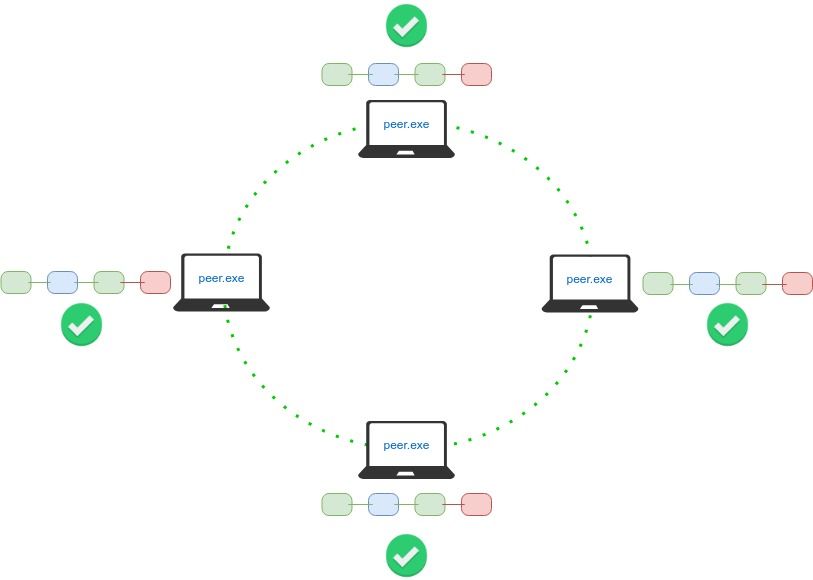
This process connects to other process instances running on other machines to receive updates on new blocks, transactions, health and validity checks etc to keep itself updated.

A transaction/block can be appended by any peer and is then broadcast-ed to all peers.

Since multiple peers are adding transactions/blocks simultaneously, the consensus protocol along with the ledger implementation ensures “validity” and ordering of transactions in blocks forming the blockchain.
We will dig in to the consensus and validity more in future lessons. Let’s start with the Bitcoin example to see how all this can create real value.
In the next chapter, we will understand the value of Blockchain through the example of Bitcoin.