Transfer Learning
Explore the concepts of transfer learning and training neural networks from scratch. Understand their differences, advantages, and when to apply each based on data availability, task similarity, and resource constraints. This lesson helps you make informed decisions in AI projects and interviews.
In modern artificial intelligence interviews—especially those focused on deep learning and generative AI—employers love to probe what methods you know and when and why you would choose one. A favorite among such questions is choosing between transfer learning and training from scratch. This reveals your practical understanding of machine learning strategy. “Should we fine-tune an existing model or build a new one from zero?” is a common dilemma in real projects, especially in GenAI-related roles. By asking “When would you prefer transfer learning over training from scratch, and vice versa?” they want to see if you grasp the concepts and the trade-offs properly, and won’t naively train everything from scratch when a smarter approach exists.

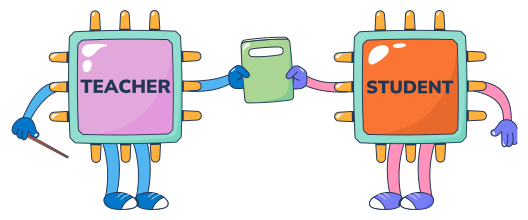
The interviewer expects you to know what transfer learning is and how it differs from training a model from scratch. They verify that you understand key factors, including data availability, computational cost, and model performance. Essentially, they want to hear that you can weigh pros and cons: using a pretrained GPT model to fine-tune for your task vs. training a brand new model. To answer effectively, you must show you understand both approaches and can articulate when each is appropriate. This informs them that you can make informed decisions when building GenAI systems.
What is transfer learning, and why is it useful?
Transfer learning is a machine learning technique where you start with a model that is already trained on one problem, and then adapt it to a new but related problem. Instead of training a brand new model from random initialization, you reuse the knowledge the pretrained model has gained. In practice, this often means taking a model trained on a large dataset (the source task) and fine-tuning it on your smaller, specific dataset (the target task). The preexisting model provides a head start—it has learned useful features or representations that can apply to your new task.
It is important to clarify that while fine-tuning is one of the most common transfer learning methods in deep learning, it is not the only approach. Under the umbrella of transfer learning, there is also the concept of feature extraction. In feature extraction, you use the pretrained model as a fixed feature extractor—its weights remain unchanged, and you only train new layers on top of these extracted features. In contrast, fine-tuning involves continuing the training process on the pretrained model, adjusting some or all of the parameters alongside the new layers to adapt the model more precisely to your task. ...