Cross-Region Replication
Explore AWS S3 cross-region replication to understand how it automatically copies objects between buckets across different AWS regions. Learn its benefits such as reducing access latency for global users, retaining key metadata, supporting diverse ownership, and meeting compliance requirements by storing data across distant locations. This lesson helps you apply replication techniques to enhance data availability and performance in AWS S3.
AWS global infrastructure
AWS offers a highly secure, reliable, and available cloud platform to develop and deploy applications globally within minutes.
Some benefits of having a robust infrastructure are listed below:
- Low latency and low packet loss
- Easy usage
- Highly reliable and available
- Fault-tolerant
- Highly secure
- High throughput
- Highly redundant networking
Regions
Regions are the largest physical hardware data centers managed by AWS. They can withstand large amounts of failure. There are 25 regions (both constructed and in-construction) in total.
Availability zones
Availability zones are slightly smaller data centers within regions that are closer to the users and store redundant data. They are used to facilitate high-speed and low latency network connectivity. Each region contains three availability zones. There are at least 81 availability zones in total.
Edge locations
Edge locations are small pockets of computing, storage, and networking facilities mainly used for edge computing and high-speed content delivery. There are 218 edge locations in total.
Local zones
Select AWS services, like compute and storage services, have moved closer to more end-users, providing them with low latency access to the applications running locally. There are 12 local zones in total.
Replication
Replication in general terms means duplication or cloning.
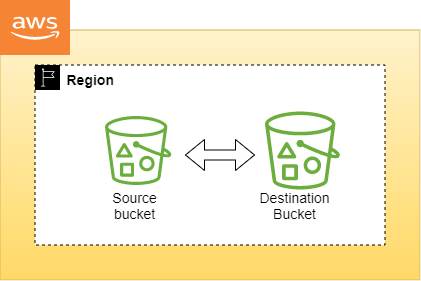
S3 cross-region replication
Replication allows the facility of duplication. Replication can be done on storage devices, computing devices, and more.
In S3, cross-region replication allows for automatic, asynchronous copying of objects across Amazon S3 buckets.
Features of cross-region replication
- Objects are replicated to destination buckets.
- The destination bucket can be single or multiple depending on need.
- It does not matter whether the destination bucket is in the same AWS region or a different one, the replication process can be easily executed.
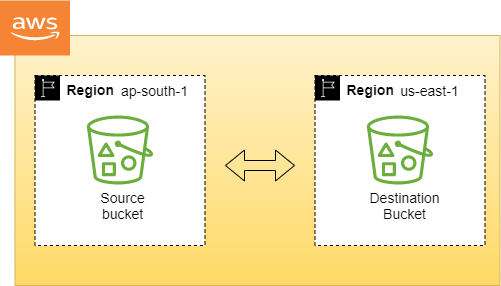
Why replication should be used
Retaining metadata
Using replication to make copies of our data helps in retaining the object metadata, version IDs, and some additional information. This information is helpful to ensure our replicated object is the same as the source object.
Maintain copies of data under different ownerships
Our source object can be under different ownership, but the owner of the destination bucket to which the object gets replicated can be entirely different.
This is particularly helpful when a larger team comprises multiple subteams such asproduction, testing, and development teams. The development team updates the object data under the ownership of the project team lead. The testing team maintains the same replicated object under their ownership. Once the updated object passes the testing process successfully, they update the object under their ownership. Following this, the production team updates their replicated object. This is a high-level example of how teams work and make use of the cross-region replication feature.
Replicate objects within 15 minutes
S3 Replication Time Control (S3 RTC) can be used to replicate our object data in the same AWS region or across different regions in 15 minutes at most.
When to use cross-region replication
Minimizing latency
Latency refers to the delay in accessing data. In technical terms, when we say latency we refer to network latency. Network latency is also referred to as lag, or in other words, the delays in communication over a network.
In networking, latency refers to the amount of time taken by a data packet to be captured, transmitted, processed through multiple devices, received at its destination, and finally decoded. Let’s suppose that we host our shopping site in an availability zone in the US, and we have customers from India. If our Indian customer tries to access that data, they will face a delay. This delay is sometimes frustrating and can result in the loss of customers.
If our customers are in two different geographic locations, we can minimize latency in accessing objects by maintaining object copies in an AWS region that is geographically closer to our users. In the above case, we would check if we have enough Indian customers to make the extra cost of using another region financially viable. If so, we can pay and start to maintain replicas in India-based availability zones. This will reduce lag for customers in India and will provide a better user experience.
Meeting compliance requirements
Amazon S3 stores our data across multiple geographically distant availability zones by default. Still, compliance requirements might dictate that we have to store data at even greater distances. Here, cross-region replication is very helpful.
Cross-region replication allows us to replicate data between distant AWS regions to satisfy the compliance requirements.