The Big Picture: Pretraining at Scale
Explore the process of pretraining large language models, where models repeatedly predict the next token in enormous datasets to develop language skills and emergent capabilities. Understand the importance of data curation, computational resources, and training dynamics that create a powerful but unaligned base model ready for further refinement.
In our last lesson, we understood the atomic unit of learning: the four-step training loop. We saw how a model gets infinitesimally smarter from a single chunk of text by making a prediction, measuring its error, and nudging its weights in the right direction.
But this raises a profound question. How do you go from that single, tiny learning step to a model that seems to understand grammar, facts, and even reason? The answer is a question of scale. What happens when you play that simple game not once, but trillions of times, on a dataset that encompasses a significant portion of recorded human knowledge? This is the story of pretraining.
The pretraining phase: Creating a base model
The pretraining phase is the colossal, computationally expensive process where a “blank slate” model is trained on an enormous corpus of raw, unlabeled text. Its goal is not to teach the model a specific task, but to force it to learn the fundamental patterns of language, facts, and reasoning in service of its one single objective: predicting the next token.

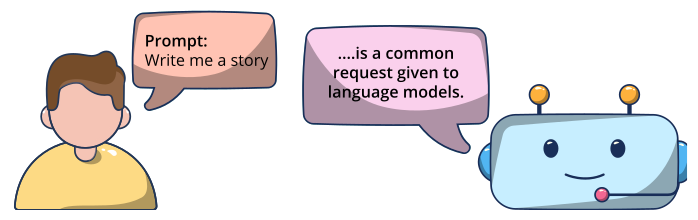
The result of this monumental effort is a base model. It is an incredibly powerful engine of language, but it is not yet a helpful assistant. A useful analogy is to think of a base model as a brilliant but socially awkward genius who has read every book in the library but has never had a conversation.
What it can do: It can complete patterns with incredible skill. If you give it a prompt like “The third president of the United States was...”, it will complete it with “Thomas Jefferson” because that is the overwhelmingly dominant statistical pattern in the data it has seen. It can write essays, summarize articles, and generate code with shocking proficiency.
What it can’t do (well): It doesn’t understand the intent of a conversation. It has no concept ...