How Does This Course Help in ML Interviews?
Explore how this course equips you to confidently tackle ML interviews by mastering system design problems. Understand how to define problems, choose metrics, design data pipelines, and explain trade-offs. Gain practical skills for designing scalable ML systems, preparing you to excel in competitive tech interviews.
The rise of machine learning
Machine learning has rapidly evolved from a niche research area into a core pillar of modern technology. The global ML market is projected to grow from $7.3B in 2020 to over $30B by 2024, driven by real-world applications such as:
-
Search ranking and recommendations
-
Speech and image recognition
-
Fraud detection and risk modeling
-
Autonomous systems and personalization

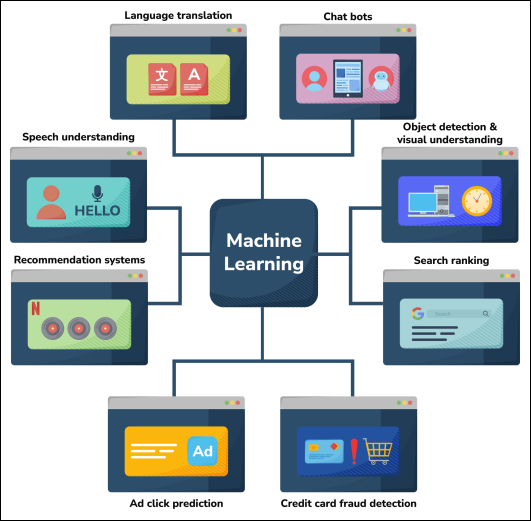
As ML adoption grows, so does the demand for engineers who can design, scale, and reason about ML systems, not just train models. This shift has fundamentally changed how ML interviews are conducted.
What to expect in a machine learning interview?
Companies hiring for machine learning roles conduct interviews to assess individual abilities in various areas. You can expect the following topics to be covered in these interviews:


1. Problem-solving and coding
This portion of the interview is fairly similar to other software engineering coding interviews where the interviewer gives a coding problem, such as perform an ‘In-order tree traversal’, and the candidate is expected to solve that in about half an hour. There is ample content available on how to best prepare for such questions.
2. Machine learning fundamentals
This area generally focuses on individual understanding of basic ML concepts such as supervised vs. unsupervised learning, reinforcement learning, classification vs. regression, deep learning, optimization functions, and the learning process of various ML algorithms. There are many courses and books that go over these fundamental concepts. They facilitate the learning of ML basics and help candidates prepare for the interview.
3. Career and behavioral discussion
Career discussion tends to focus on an individual’s resume (previous projects) and behavioral aspects, such as the ability to work in teams (conflict resolution) and career motivation. Understanding the path you want to take in your career and having the ability to discuss previous experiences and projects is required for this portion.

4. Machine learning system design
This is where many candidates struggle. In the ML system design interview, you’re given an open-ended problem and asked to design an end-to-end machine learning system. Examples include:
-
Designing a product recommendation system
-
Building a search-ranking model
-
Creating a fraud detection or ad-click prediction system
Unlike traditional ml interview questions, these problems don’t have a single “correct” answer. Interviewers care about how you think, how you structure the solution, and how you reason about trade-offs.
This is also the area with the least structured preparation material, and exactly where this course helps.
Why this course is valuable for ML interview prep
Most ML resources focus on algorithms, math, or model training. Very few teach you how to approach ML problems from a system design perspective.
This course fills that gap.
-
You’ll learn how to:
-
Break down vague ML interview questions into clear problem statements
-
Define success metrics and constraints
-
Design training and inference pipelines
-
Think about scalability, latency, and reliability
-
Explain trade-offs clearly and confidently
We study real ML system design problems inspired by companies like Google, Netflix, Meta, Microsoft, and Twitter, and apply a consistent framework to each one.
How to approach ML system design questions
Throughout the course, you’ll follow a structured, repeatable approach to ML system design interviews, including:
-
Understanding the problem and business goal
-
Identifying key metrics and constraints
-
Designing data, training, and inference components
-
Scaling the system and handling failures
This framework is introduced in detail in the next lesson and reused across multiple problems, so by the time you reach interviews, the thinking pattern feels natural.


Practical ML techniques you’ll learn
In addition to system design, the course also covers practical ML techniques commonly discussed in interviews, such as:
Embeddings and feature representation
Online experimentation and A/B testing
Model debugging and evaluation
Performance and capacity considerations
These topics often appear as follow-up questions in ML interviews and can be decisive.
Final takeaway
This course is designed to strengthen the one area that most ML candidates find hardest: explaining and designing end-to-end machine learning systems under interview pressure.
If you’re serious about ML interview prep and want to confidently handle real-world ML interview questions, this course will give you the structure, intuition, and confidence to stand out.
Happy learning, and best of luck with your interviews.