Text Summarization
Explore text summarization using Llama 3 to convert lengthy texts into concise summaries. Understand extractive and abstractive approaches, apply prompting techniques, and fine-tune parameters to control output quality. Learn practical applications and how to generate summaries tailored to specific needs.
Text summarization is the process of converting a long piece of text into a shorter version while keeping the meaning of the original text. It helps people understand large volumes of information quickly by grasping essential details without the need to read the complete text.
Types of text summarization
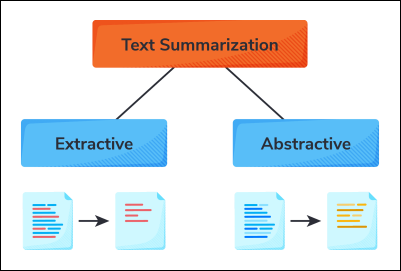
There are two ways to summarize the text, i.e., extractive summarization and abstractive summarization. Let's understand how these approaches work.
Extractive summarization
This is the process of generating the summary by extracting the sentences from the original text that are important to understand its meaning. Extractive summarization only uses text from the original text without adding any rephrasing in the summary. This approach is preferable where speed and factual accuracy are concerned, as it is computationally efficient and fast.
Abstractive summarization
This is the process of generating a summary by rephrasing the original text so that it retains its meaning. However, because it involves rephrasing the text, it can sometimes lack factual accuracy. Abstractive summarization is preferable where readability and capturing the overall meaning of the text are concerned.

Let's go through some real-life examples where text summarization actually helps.
Research and study: Researchers and students often have to deal with long academic and research papers. Text summarization helps them skim through these papers to extract core information and findings in no time.
Business: ...