Linked List Cycle
Understand the method to detect cycles in a linked list by using fast and slow pointers. This lesson helps you identify if a linked list loops back on itself, enhancing your ability to solve cycle detection problems efficiently.
We'll cover the following...
Statement
Given the head of a linked list, determine whether the list contains a cycle. A cycle exists if a node in the list can be revisited by continuously following the next pointers. Return TRUE if a cycle is present; otherwise, return FALSE.
Constraints:
Let n be the number of nodes in a linked list.
-
n -
Node.value
Examples
Understand the problem
Let’s take a moment to make sure you’ve correctly understood the problem. The quiz below helps you check if you’re solving the correct problem:
Linked List Cycle
What is the output if the following linked list is given as an input?
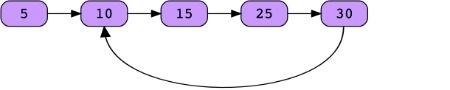
TRUE
FALSE
Figure it out!
We have a game for you to play. Rearrange the logical building blocks to develop a clearer understanding of how to solve this problem.
Try it yourself
Implement your solution in the following coding playground.
# The first input of the test case is an array of values representing a linked list.# The second input is the index where the tail connects to form a cycle (or −1 if there's no cycle).# This index is used only to construct the linked list and is not passed to the function.# Definition for a Linked List node# class ListNode:# def __init__(self, val=0, next=None):# self.val = val# self.next = nextfrom ds_v1.LinkedList.LinkedList import ListNodedef detect_cycle(head):# Replace this placeholder return statement with your codereturn False