Codex vs. Cursor vs. Gemini Code Assist
Understand the unique features, strengths, and limitations of OpenAI Codex, Cursor, and Google Gemini Code Assist. Learn how each AI code assistant fits different developer needs from local scripting to enterprise-grade security. This lesson helps you choose the right AI tool based on project scale, integration, and workflow priorities for efficient and secure AI-assisted development.
In the previous lesson, we established how Cursor's AI-first philosophy shifts development from manual implementation to high-level strategic thinking. But how does this approach compare to other enterprise-grade AI tools on the market?
When modernizing a professional development workflow, engineering teams must evaluate which AI paradigm best fits their specific security, infrastructure, and productivity needs. Today's AI-powered tools have moved far beyond basic syntax highlighting; they act as collaborative partners.
This lesson dissects three of the most prominent AI code assistants shaping this revolution: OpenAI Codex, Cursor, and Google Gemini Code Assist. By the end of this module, you will have a clear framework for understanding where Cursor fits within the broader enterprise landscape, enabling you to make informed decisions for your team's architecture and workflow.
Let’s examine the unique philosophies behind each tool.
What is OpenAI Codex?
OpenAI Codex has come a long way since it first appeared in 2021. Back then, it was an API-first model built on top of GPT-3 and fine-tuned on publicly available code. Its main job was to turn our natural language instructions into working code. That early version powered the first GitHub Copilot and quickly proved that it could handle a number of features, as mentioned below.


Code generation: Turn prompts into complete functions, scripts, or even full files.
Code completion: Finish lines, functions, or boilerplate we’d started.
Language translation: Convert code between programming languages with impressive accuracy.
This API-only setup offered us a ton of flexibility. We could plug Codex into custom tools, automate workflows, and connect it to any environment we wanted. The trade-off was that we had to handle all the integration ourselves, and it didn’t give us a built-in IDE experience.
The Codex web agent (in ChatGPT)
Fast forward to May 2025, and Codex stepped into a new role as a fully-fledged software engineering web agent inside ChatGPT. Now powered by codex-1, a next-generation coding model based on OpenAI’s o3 reasoning architecture and fine-tuned on real-world pull requests, it works like a virtual teammate. It can:

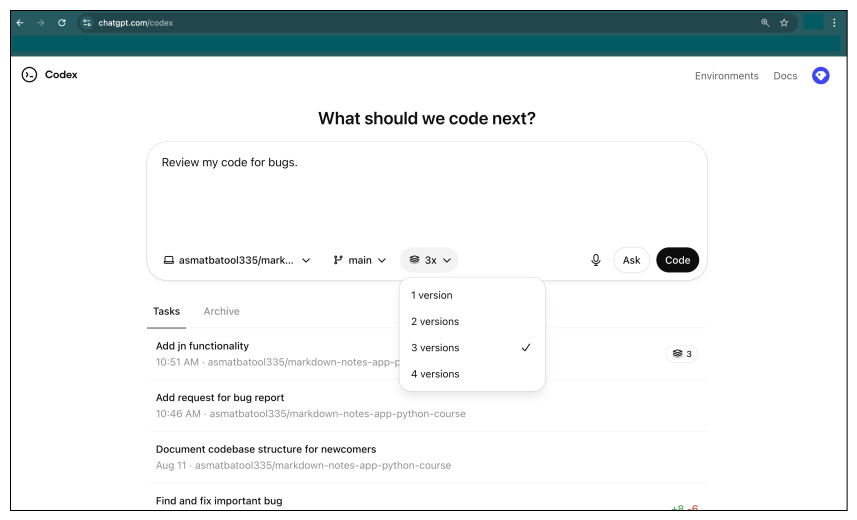
Connect to our GitHub repository and work inside a secure, sandboxed cloud environment.
Automate jobs like documenting architecture, refactoring modules, or fixing urgent bugs.
Draft pull requests, propose changes, and run linting/tests before we merge anything.
Suggest multiple possible solutions so we can pick what fits best.
Keep a detailed, verifiable log of every action for transparency and security.
We can also tweak its environment with domain allowlists, and choose whether it has internet access (off by default for safety ...