AI Image Generation: Diving into Diffusion Models
Explore the principles of AI image generation through diffusion models. Understand their forward and reverse noise processes, the role of U-Net and diffusion transformers, and how text prompts guide image creation. Discover the strengths, limitations, and applications of diffusion models in vision AI.
Image generation refers to AI systems that can create entirely new images from scratch based on a user’s description, rather than just recognizing or classifying existing ones. The model learns visual patterns from large image datasets and then synthesizes original pictures that match the prompt.
Imagine asking an AI, “Draw a picture of a cat riding a unicorn in space in a cartoon style.” And just like that, it generates an image that brings your idea to life! While the AI might add creative touches, a well-crafted prompt helps guide it toward the perfect result. This is the magic of generative vision AI, driven by powerful techniques like diffusion models.

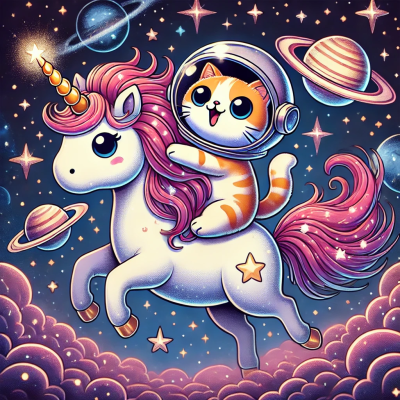
It looks great, right? Behind it is a technique so powerful that it turns seemingly random noise into stunning visuals. Who knows, maybe the secret to modern AI creativity lies in a process that transforms chaos into art.
What are diffusion models?
Let’s simplify it. Imagine starting with a picture that looks nothing like anything you recognize: just a jumble of static, like the snowy screen of an old TV with no signal. Now, picture that static gradually transforming, bit by bit, until a clear, detailed image appears from the chaos. That’s the essence of diffusion models.
Diffusion models are generative models that learn to turn random noise into a clear image through a step-by-step process. Training has two phases:
Forward process: Start with a clean image and gradually add noise over many steps until it becomes pure static, so the original picture is no longer recognizable.
Reverse process: Train a model to undo this process, removing a little noise at each step and reconstructing the underlying structure.
After training, the model can start from pure noise and repeatedly apply this learned reverse process to generate new images from scratch, often guided by a text prompt. Unlike VAEs or GANs, diffusion models are explicitly built around this noise-to-image transformation, which is what gives them their strong image quality and stability.
Are diffusion models better than VAEs or GANs?
Before we compare, it helps to recall what came before. VAEs (variational autoencoders) compress an image into a latent code and then reconstruct it, allowing them to generate smooth variations; however, their reconstruction objective often ...