Reconstructing Context with Sequence Models
Explore how sequence models capture word order and context in language processing. Understand CNNs for local patterns, RNNs for sequential memory, and LSTMs for long-term dependencies. This lesson helps you grasp their roles and limitations in building modern generative AI systems.
We’ve seen how techniques like TF-IDF and GloVe help computers understand the relationships between words. Think of them as LEGO bricks, each representing a word. They’re useful for spotting which words often appear together. The problem is that even advanced tools like GloVe always assign the same brick to a word. So “bank” looks identical whether we mean a financial institution or the side of a river. These are static embeddings.
But language is more than a bag of bricks. Meaning comes from the sequence and context, how earlier words shape the ones that follow. To capture the entire story, we need models that not only store words but also remember their order and connections.
That’s where sequence models come in. They’re like LEGO sets that not only give you the pieces but also keep track of how you assemble them, preserving the structure of the story.

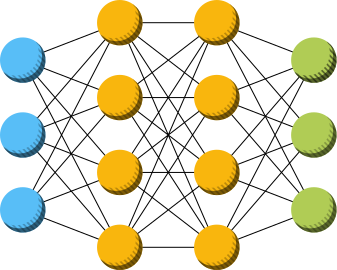
In this lesson, we will explore sequence models that capture order and context. We will understand convolutional neural networks (CNNs) for local patterns, recurrent neural networks (RNNs) for memory, and long short-term memory networks (LSTMs) for overcoming RNN limitations. Clear analogies and simple math will show how these models support modern generative AI.
Why sequence models?
Imagine building a sentence out of LEGO bricks. Earlier methods, such as TF-IDF and GloVe, provided us with colorful bricks that capture word relationships, but each brick was fixed. So the word “bank” looked the same whether in a financial context or by a river.
Language, however, depends on order and context. “I went to the bank to deposit money” means something very different from “The boat floated near the river bank.” Static embeddings miss this nuance.
Sequence models solve this by processing embeddings while remembering the sequence. They don’t just see which words appear, but also how they are arranged, like LEGO sets that recall the order of assembly. This makes them essential for translation, summarization, and generative text creation.
Answer the following question in the widget below:
Consider languages that rely heavily on word order for meaning versus languages that use case markers or characters to convey grammar. How might the effectiveness of sequence models change when word order isn’t the sole key to decoding a sentence?
What are convolutional neural networks (CNNs)?
Convolutional neural networks (CNNs) were first designed for image recognition. They scan small regions of an image to detect patterns like edges or curves. Instead of analyzing every pixel at once, CNNs slide filters across the image to find useful features.
In text, CNNs apply the same idea to word embeddings. A filter moves across sequences of words to capture local patterns, much like spotting short phrases. For example, a three-word filter might detect “not very good,” a strong signal of negative sentiment.
Pooling layers then summarize the most important features, keeping only the strongest signals. CNNs are fast and effective at identifying local patterns, but they struggle with long-range dependencies and cannot fully capture sequence context on their own.


In generative AI, CNNs have mainly been used for early text classification and feature extraction. Since they focus on local patterns, they are often paired with other models to capture broader context for coherent language generation. In this lesson, we highlight their role in text, but in the next chapter we will explore their traditional strength in image processing and see how their design shaped modern computer vision.
What are recurrent neural networks (RNNs)?
Unlike CNNs, which focus on fixed windows, recurrent neural networks (RNNs) are designed to handle sequences. They process inputs one step at a time while carrying forward a hidden state, a kind of running memory that captures information from previous steps. This allows them to “remember” earlier words when predicting or generating the next ones.
For example, when generating subtitles, an RNN reads one word at a time and updates its hidden state so that each new word is informed by the context of the previous ones. This makes RNNs effective for tasks like sentiment analysis, translation, text generation, speech recognition, and even financial forecasting.
RNNs were a breakthrough because they showed that neural networks could generate sequences, not just classify data. However, they also face challenges with very long sequences, where information from distant steps either fades or becomes amplified. These challenges led to the development of improved architectures, such as LSTMs, GRUs, and later transformers, which better capture long-range dependencies.


Although transformers dominate modern generative AI, RNNs remain an important milestone and are still useful in scenarios where sequential data matters but extreme complexity isn’t required.
What are long short-term memory (LSTM) networks?
Recurrent neural networks (RNNs) process sequences step by step, but they struggle with long sequences because earlier information fades away, a problem called the vanishing gradient. For example, an RNN may forget the subject of a long sentence by the time it reaches the end.
Long short-term memory (LSTM) networks were designed to address this issue. They have a built-in memory system that can preserve important details over long spans while discarding irrelevant ones. This makes them especially effective for tasks where long-term context matters, such as language translation, text generation, and time-series forecasting.
At the core of LSTMs is a gated architecture. Three gates control the flow of information:
The input gate decides what new information to store.
Forget gate clears out what is no longer needed.
The output gate determines what information is passed forward.
By balancing what to remember and what to forget, LSTMs overcome the weaknesses of basic RNNs and can handle much longer dependencies, making them a key milestone in the path toward modern generative AI.


Unlike basic RNNs that risk losing context over time, LSTMs maintain a long-term memory that preserves key information, such as the subject of a sentence or patterns in time series data. This makes them effective for generating coherent, context-aware outputs in tasks like translation, speech recognition, and text generation.
What if human language wasn’t linear—no clear start or end, just a network of ideas interconnected? Could RNNs, LSTMs, or any sequence model handle that kind of “timeless” language?
Before transformers, LSTMs were the backbone of generative AI, showing that neural networks could generate coherent, context-aware sequences rather than just classify data. Transformers now dominate because they process data in parallel and handle longer dependencies more efficiently. Still, LSTMs remain useful, especially in cases where simpler models are sufficient or computational resources are limited. Their gated design also continues to inspire modern neural architectures.
Why aren’t sequence models enough for complex language tasks?
CNNs, RNNs, and LSTMs were crucial steps in moving from static word embeddings to dynamic, context-aware representations. CNNs captured local patterns, RNNs introduced memory, and LSTMs extended that memory with smarter gating. Together, they proved that machines could generate coherent, human-like text.
Still, each model has limits. CNNs focus only on short windows, RNNs struggle with long dependencies, and LSTMs, though stronger, are still sequential and computationally heavy. These limitations opened the door to more powerful architectures like transformers.
Here’s a summary of their key strengths, limitations, and common use cases:
Model | Strengths | Limitations | Typical Use Cases |
CNNs | Excellent at capturing local patterns (e.g., detecting n-grams) Parallelizable which makes it really fast Low computational cost for local feature extraction | Fixed window sizes limit context capture Ineffective at modeling long-range dependencies Not designed for sequential data processing | Text classification Feature extraction in NLP Image recognition (originally) |
RNNs | Processes input sequentially, preserving temporal context Handles variable-length sequences Straightforward architecture for sequence modeling | Prone to vanishing/exploding gradients with long sequences Limited ability to capture long-range dependencies Sequential nature hinders parallel processing | Language modeling Speech recognition Basic sequence prediction |
LSTMs | Gated architecture overcomes the vanishing gradient problem Better at capturing long-range dependencies than simple RNNs Selectively retains important information over time | More complex and computationally intensive Still limited by sequential processing, affecting parallelism Longer training times due to added complexity | Machine translation Text generation Time-series forecasting |
As we’ve seen, traditional sequence models still struggle with mapping entire input sequences to outputs, especially for long or complex texts. This limitation led to the next leap in AI: the development of encoder–decoder architectures. With a solid grasp of CNNs, RNNs, and LSTMs, we are now ready to explore these advanced models that push the boundaries of what machines can understand and generate.