Junit 5 Architecture
Explore the architecture of JUnit 5 and understand its three core components: the Platform as the testing foundation, Jupiter for modern test programming, and Vintage for backward compatibility. This lesson helps you grasp how these parts work together to support Java unit testing frameworks.
We'll cover the following...
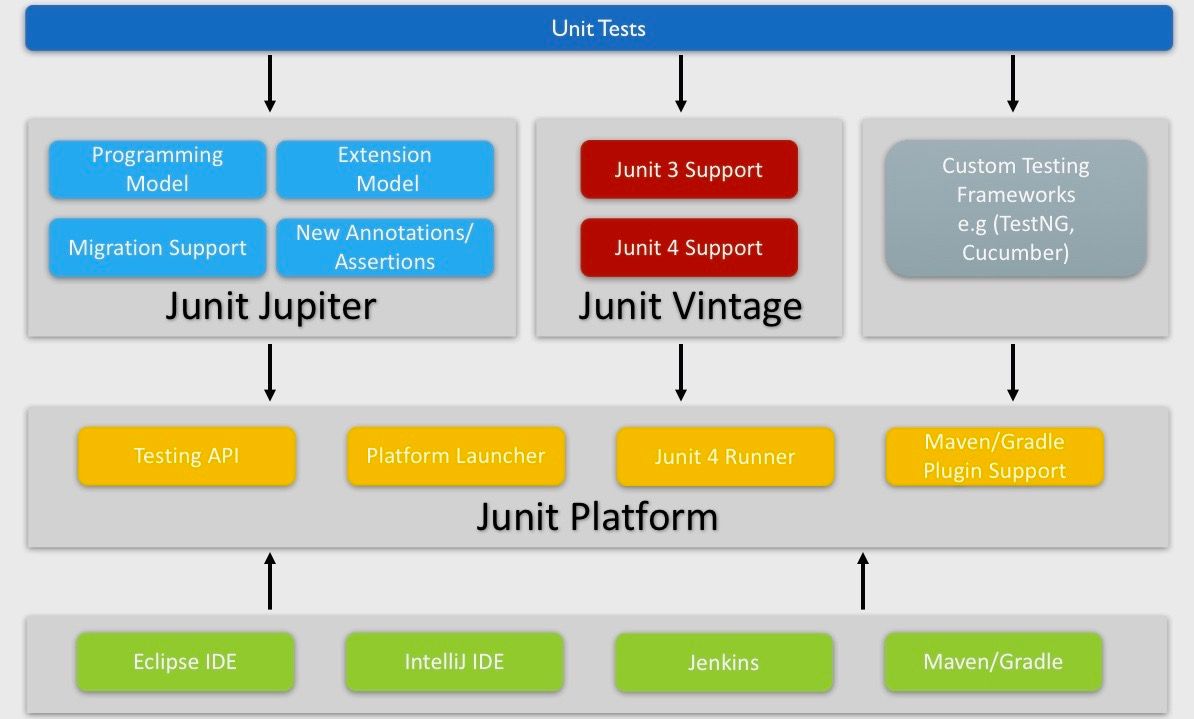
Junit 5 Architecture has three main components -
-
Junit Platform
It provides a core foundation to help launching testing frameworks on JVM. It acts as an interface between JUnit and its clients such as build tools (`Maven and Gradle`) and IDE's (`Eclipse and IntelliJ`). It introduces the concept of a `Launcher` which external tools use to discover, filter, and execute tests.
It also provides the TestEngine API for developing a testing framework that runs on the JUnit platform. Using TestEngine API, 3rd party testing libraries such as Spock, Cucumber, and FitNesse can directly plug in and provide their custom TestEngine.
-
Junit Jupiter
It provides a new programming model and extension model for writing tests and extensions in Junit 5. It has a whole new annotation to write test cases in Junit 5. Some of the annotations are `@BeforeEach`, `@AfterEach`, `@AfterAll`, `@BeforeAll` etc. It implements TestEngine API provided by Junit Platform so that Junit 5 test can be run. -
Junit Vintage
The term `Vintage` basically means **classic**. Thus, this sub-project provides extensive support for writing test cases in JUnit 4 and JUnit 3. Thus, backward compatibility is been provided by this project.

Quiz on JUnit 5 Architecture
JUnit 4 test cases are run on JUnit Vintage Engine.
True
False
Quiz on JUnit 5 Architecture
JUnit 5 test cases are run on JUnit Jupiter Engine.
True
False
In the next lesson, we will learn to create our first JUnit 5 test case.