What Is Machine Learning?
Explore the fundamentals of machine learning, including its definition, key applications, and how it contrasts with traditional programming approaches. Understand the machine learning process from problem formulation to deployment, and learn about the three main types: supervised, unsupervised, and reinforcement learning. This lesson equips beginners with the foundational knowledge needed to start working with machine learning in data science.
Now that we’ve explored how to collect, clean, and analyze data to uncover insights, we’re ready to move forward. The next step is turning those insights into action by building systems that can learn from data and make predictions. That’s where machine learning comes in.
Let’s start with something familiar. Think about how our music apps seem to know our taste, how voice assistants answer our questions, or how our phones unlock with just a glance. It might feel like magic, but it’s machines learning from data. They spot patterns and use those patterns to make decisions on new inputs. That’s the power of machine learning—and it’s a core skill for any data scientist.
Machine learning
Machine learning is like teaching a child to recognize a cat—not by writing rigid “if–then” rules (“if it has pointy ears and whiskers, then it’s a cat”), but by showing many examples and letting the learner discover the patterns. In this analogy, data serves as our teacher, the algorithm is our lesson plan, and the trained model is the student that learns to classify or predict. The data scientist orchestrates this entire learning process.
Through this approach, computers learn from examples and steadily improve performance without explicit instructions for every scenario. The magic happens when algorithms analyze training data paired with known outcomes (labels) to uncover hidden patterns. Once trained on hundreds of labeled images (say, apples vs. pears), a machine-learning model can correctly identify new images it has never seen before.

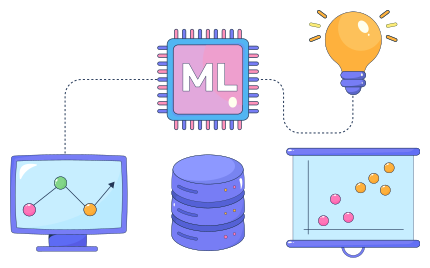
Machine learning is powering many of the tools and services we use every day:
Spam filters learn to distinguish junk from important emails by analyzing patterns in past messages.
Recommendation engines on platforms like Netflix, YouTube, and Spotify adapt to our viewing or listening habits to suggest what we’ll enjoy next.
Voice assistants like Alexa and Siri use ML to interpret speech, understand intent, and improve their responses ...