Relational Operators
Explore how relational operators in R perform comparisons by returning TRUE or FALSE values. Understand element-wise comparisons for vectors, the role of the %in% operator, and how R handles vectors of unequal lengths to produce logical outputs.
We'll cover the following...
What are Relational Operators?
Relational Operators are used for comparing objects. They return a boolean variable, i.e., TRUE or FALSE.
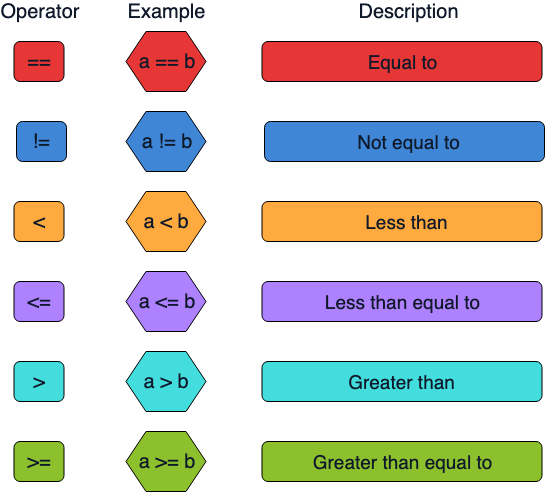
Let’s have a look at the code:
If you use a relational operator to compare vectors, R will do element-wise comparisons.
The output of performing relational operations on two vectors is a vector!
The %in% operator
The %in% operator is used only on vectors and it is the only operator that does not do normal element-wise execution.
%in% checks whether the value(s) on the left side are present on the right side. This means %in% tests whether each value on the left is somewhere in the vector on the right:
When using relational operators to compare vectors, if the two vectors are of unequal length, R tries to equalize them by replicating the smaller one.
If the vector on the left-hand side has multiple elements, each element is searched in the vector on the right-hand side. Individual TRUE or FALSE values are produced as a result.