AWS Cost Optimization Approach
Explore the AWS cost optimization approach by understanding how design decisions impact spending. Learn to use the AWS Well-Architected Framework's cost optimization pillar and tools for efficient, secure, and scalable cloud workloads.
We'll cover the following...
AWS wants us to run our workloads in the most secure, stable, and efficient way possible. But why would they want us to save money and not spend more money? Because they know the market, and they know that cloud computing has become a commodity.
All the major cloud vendors have mostly the same suite of services and tools—maybe with different names or different architectures. While it's not something anyone would want to do all the time, moving to a different cloud provider isn’t as monumental a task as one would think.
The balance has shifted
With the advent of virtualization, containerization, and architectural patterns like loosely coupled design, canonical forms, and open standards, portability among cloud providers isn’t that bad. Of course, the major heavy lifting comes from the need to migrate to those architectural patterns in the first place, and many companies use cloud migration to do just that.

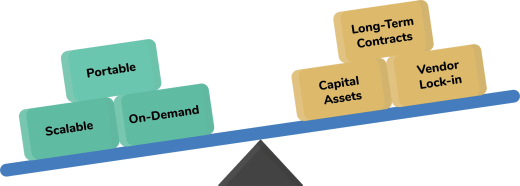
Given that cloud computing is a commodity market, there are certain things a company must provide if they want to be competitive in the cloud computing market. Things like security, reliability, top-notch customer support, and a strong developer ecosystem are just expected. Methods to minimize cost are certainly competitive features as well. While all these things are present on the AWS platform, it does take some know-how to use them to their fullest.
Just like it takes some knowledge to properly design and set up a DynamoDB table for peak performance, it also takes some knowledge to design that DynamoDB table so that we end up with the smallest bill possible. That’s right; how we design things can have a massive impact on how much it costs to run that workload on AWS. Cost is not just an inconvenient by-product of running workloads on AWS—it should be part of our overall architectural approach.
AWS Well-Architected Framework
AWS has codified the practices that it believes are the best way to use its services in something called the AWS Well-Architected Framework. Within the framework, AWS has defined six key topics that it considers foundational, referring to them as Pillars. These Pillars are as follows:
Operational excellence
Security
Reliability
Performance efficiency
Cost optimization
Sustainability
See, right there in AWS’s handbook for using AWS, cost optimization is considered something just as important as security or reliability. Rather than define a cookbook recipe for how to run workloads on AWS, the framework helps us understand some trade-offs. AWS has also created what it calls lenses, which augment the base framework. These include more specific items for industries, like healthcare and financial services, and common workloads, like SAP implementations and machine learning.
💡Pro Tip: AWS has a free tool called the AWS Well-Architected Tool that helps walk you through the framework using a questionnaire-style format. You can even choose which pillars you consider higher priority than others to help guide you through the various trade-offs.
As one would expect, there are plenty of resources out there on this topic in white papers, blogs, and documentation. Because that documentation is written to apply to virtually any scenario under the sun, it is strong on generalities and often weak on specifics. This course attempts to distill down the recommendations and then provide some specific examples you can implement to (hopefully) optimize your AWS spending.
A new cloud perspective
Here are some quotes that frequently come up in organizations that are transitioning from on-premises to a cloud-based landscape. Click “Show Answer” to reveal how these perspectives can hold back your cost optimization efforts.
“Shouldn’t we size everything for peak demand and then some buffer as well? Better to be safe than sorry!”