The Dual Problem of Minimum Vertex Cover
Learn to identify the minimum set of vertices covering all edges in a graph, understand the connection between vertex covers and matchings, and explore the Konig-Egervary theorem which equates maximum matching size to minimum vertex cover in bipartite graphs.
We'll cover the following...
Suppose neighborhood surveillance is required for a network that consists of streets meeting at junctions. We’d like to install the smallest number of cameras at the junctions so that all the streets can be surveilled. Such a neighborhood can be modeled as a graph by considering the junctions as vertices and the streets as edges.
The problem then is to find the smallest set of vertices (junctions) that provide a cover to all edges (streets), and this problem is known as the minimum vertex cover problem.

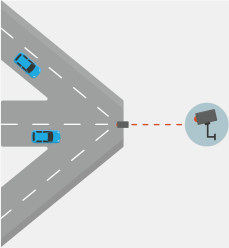
Vertex cover
A vertex cover of a graph is a set of its vertices such that every edge of is incident with at least one vertex in that set. A vertex in the vertex cover is said to cover all ...