Introduction to Customer Segmentation
Explore customer segmentation by learning clustering methods such as k-means and hierarchical clustering, along with RFM segmentation. Understand how to use customer attributes for better marketing strategies and decision-making based on distinct customer groups.
We'll cover the following...
Customer segmentation
Not all customers behave the same way. Customers’ activities and interests vary depending on their income level, age, location, and other situations. Certainly, the “one size fits all” approach is not applicable in modern marketing. We might offer discounts to one group of customers and run an ad campaign for other groups of people. Only a deeper understanding of customer demographic, psychographic, and behavioral attributes can help us understand our customer’s needs and use the proper strategies to serve them better.

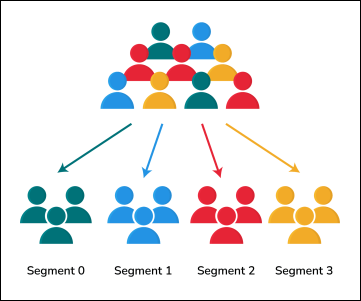
There are several approaches to segmenting the customer base. Three popular options are hierarchical clustering, k-means clustering, and Recency, Frequency, and Monetary (RFM) segmentation.
Hierarchical clustering
Hierarchical clustering groups pairwise samples together based on similarities and moves up to the next level of hierarchy by merging those pairs of clusters. Finally, it forms a dendrogram (a tree structure). Based on this dendrogram, expert analysts ...