Forecast Confidence
Explore how forecast confidence intervals quantify uncertainty in time series predictions using ARIMA models. Understand the role of forecast errors and variance in defining interval bounds, enhancing your ability to interpret and trust your model's forecasts.
We'll cover the following...
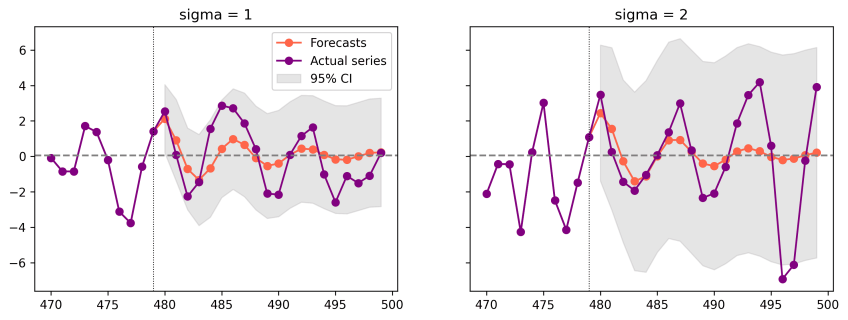
Estimating the next point in a time series is only half of the forecasting job. The confidence around that point is just as important, if not more. Let’s think in terms of the weather. Forecasting that tomorrow’s temperature will be 68˚F is useless if the forecast is ±30˚F. However, if the interval is ±2˚F, we won’t really mind if the temperature ends up being 66˚F instead of 68˚F.
As this simple example illustrates, we can’t provide a point forecast without a confidence interval. A confidence interval will tell us the window where the realization of

Definition
Let’s define our forecast error,