Diverse Autoencoders and Their Applications
Understand and apply various autoencoder models such as undercomplete, overcomplete, denoising, contractive, and sparse autoencoders. Learn how these models are used for dimensionality reduction, noise robustness, and feature extraction in predictive analytics and anomaly detection.
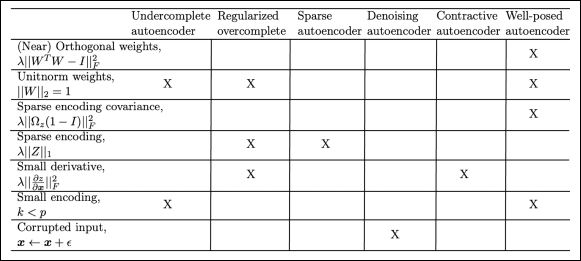
There are several types of autoencoders. The table below summarizes the properties of the most common autoencoders. The rest of this lesson briefly describes them along with their applications.

Undercomplete autoencoders
An undercomplete autoencoder has a smaller encoding dimension than the input. A simple example of such an autoencoder is
Here, the input and the encoding are - and -dimensional, respectively, and .
In learning a smaller representation, an undercomplete autoencoder gathers the most salient features of the data. The learning process is simply minimizing a loss function,
where is a loss function, for example, mean squared error, that
penalizes dissimilarity between and .
Undercomplete autoencoders are more common. Perhaps because it has roots in
which is the same as PCA if ...