Fallacies of Relevance
Explore the concept of fallacies of relevance to recognize when arguments rely on irrelevant factors like emotions, authority, or personal attacks. This lesson helps you understand common examples, from appeals to emotion to straw man arguments, enabling you to evaluate arguments critically and avoid being misled by faulty reasoning.
Fallacies of relevance involve arguments that are not logically connected to the issue or are based on irrelevant factors, like emotions, authority, or popular opinion. We’ve already seen one example in the previous case study of politicians jumping to irrelevant conclusions. This lesson uses examples from politics and everyday scenarios to illustrate some common fallacies of relevance so we can navigate our lives more logically.
Appeal to emotion
Let’s imagine a politician on social media fallaciously arguing using an appeal to emotion, as shown below.

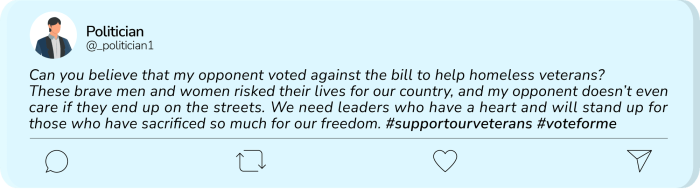
In this post, the politician uses emotional language to appeal to his audience’s gratitude and respect for war-returned veterans. By framing the opponent’s vote as heartless and uncaring, the politician tries to sway voters based on their emotions rather than on the merits of the bill or the opponent’s actual position. This is an example of the appeal to emotion fallacy.
The actual bill in question could be about funding for homeless veterans, but the post is using emotional language to create a false narrative. It’s possible that the opponents voted against the bill not because they don’t care about homeless veterans but because they have concerns about the funding mechanism or because they believe there are more effective ways to address the issue. The politician engages in fallacious reasoning by misrepresenting the opponent’s position and appealing to the audience’s emotions.
It’s important to have a reasoned and fact-based discussion about important issues like supporting homeless veterans rather than relying on emotional appeals and false narratives to win support.
Can you think of a scenario for the same type of fallacy—appeal to emotion—but in a non-political scenario?
Ad hominem
Here’s an example of a politician on social media using the fallacy of ad hominem.


In this post, the politician attacks the opponent’s personal financial management skills to discredit their ability to speak on economic policy. The politician suggests that the opponent’s financial situation makes them unqualified to speak on economic policy without actually engaging with the substance of their argument.
This is an example of the ad hominem fallacy, which is a type of fallacy that attacks the person making an argument rather than the argument itself. It’s important to evaluate arguments based on their actual merits rather than being swayed by personal attacks or irrelevant information about the person making the argument.
Can you think of a scenario for the same type of fallacy—ad hominem—but in a non-political scenario?
Appeal to force
Here’s an example of a politician on social media using the fallacy of appeal to force.

This post uses the appeal to force fallacy by implying that there will be negative consequences if the audience doesn’t vote for the politician. The consequences in this case are more specific and elaborated upon, such as missing out on the benefits of the politician’s policies and being left behind while the rest of the country progresses.
Again, it’s important to recognize that this type of argument is fallacious and should be avoided. Arguments should be based on merit and provide evidence or logical reasoning in their support, rather than relying on fear or intimidation to persuade people to take a certain action.
Can you think of a scenario for the same type of fallacy—appeal to force—but in a school setting?
Can you think of a scenario for the same type of fallacy—appeal to force—but in a parent-child setting?
Appeal to inappropriate authority
Here’s an example of a politician on social media using the fallacy of appeal to inappropriate authority.

In this post, the politician attempts to lend credibility to their economic plan by referencing the endorsement of a renowned actor, John Doe. By highlighting the actor’s support, the politician implies that their plan is inherently superior and should be embraced by the public.
The fallacy of appeal to inappropriate authority occurs when someone relies on the endorsement or opinion of an authority figure who lacks expertise or relevance in the given subject matter. In this case, the actor’s expertise lies in the field of entertainment and not economics or public policy. Therefore, their endorsement doesn’t necessarily validate the effectiveness or superiority of the economic plan.
When engaging in discussions or evaluating proposals, it’s important to consider evidence, logical reasoning, and expertise from relevant authorities to form well-informed opinions.
Can you think of a scenario with the fallacy of appeal to inappropriate authority, but in a non-political context?
Appeal to the populace
Here’s an example of a politician on social media using the fallacy of appeal to the populace.

In this post, the politician uses the appeal to the populace fallacy by suggesting that their stance is correct simply because it’s supported by the majority of people. They imply that those who disagree are in the minority and, therefore, wrong or out of touch. However, this argument fails to address the actual merits of the stance or provide logical reasoning to support its claims.
Can you think of a scenario for the same type of fallacy—appeal to the populace—but in an advertising industry setting?
Straw man argument
Here’s an example of a politician on social media using a straw man argument.


In this example, the politician misrepresents their opponents’ position by claiming they want to completely defund the healthcare system. By portraying their opponents as extreme proponents of eliminating healthcare funding entirely, the politician creates a straw man argument. This misrepresentation allows the politician to present their own stance as more reasonable and balanced while avoiding engaging with the nuanced arguments and proposals put forth by their opponents.
The essence of the straw man fallacy lies in mischaracterizing an opponent’s argument in a way that distorts their actual position, making it easier to dismiss or attack. In this scenario, the opponents might be advocating for a regulation or audit to address potential signs of corruption within the healthcare system. However, the politician misrepresents their opponents’ position by framing it as a call for complete defunding, which is an exaggerated and distorted representation of their actual argument.
Can you think of a scenario for the same type of fallacy—a straw man—but in a non-political scenario? Imagine two friends discussing healthy eating.
Red herring
Here’s an example of a politician on social media using the fallacy of red herring.

In this post, the politician introduces a red herring by shifting the focus of the argument from their stance on higher taxes on businesses to their opponent’s personal life and scandals. By bringing up their opponent’s personal issues, the politician attempts to divert attention from the original point of discussion—their position on tax policies.
The red herring fallacy involves introducing an irrelevant or unrelated topic into an argument to divert attention and avoid addressing the main point. It’s crucial to stay focused on the substantive issues and address the specific claims or arguments presented, rather than using diversionary tactics to shift the discussion away from the original topic.
Can you think of a scenario for the same type of fallacy—a red herring—but in a non-political scenario?
Exercise
Imagine you’re a teenager who has come home a little late, and you’ve just heard your parents say, “We believe it’s important for you to adhere to the curfew we’ve set. It’s for your safety and helps establish a sense of responsibility.” You’re now given a chance to argue with your parent. What kind of argument would you pitch? Your parents let you have three attempts. Give it a shot and let our AI-enabled tool act as the parent.