Predicate Logic
Explore predicate logic, its historical context, and how it builds on Aristotelian syllogism and propositional logic. Learn to use quantifiers and predicate functions to construct and validate more expressive and complex logical arguments.
This lesson introduces predicate logic in comparison and continuation of the previous two historical attempts at theorizing logic—Aristotelian syllogism and propositional logic.
Review of the first theory
Aristotle’s colossal contributions to the foundations of logic can never be forgotten, just like his contributions to almost all major knowledge domains.
Summary of Aristotelian syllogism
Aristotle laid the foundations for the formal study of logic but scoped his study to categorical syllogisms, restricted to
The power of the theory
Even with such constraints, logicians could represent many real-world situations and judge the arguments as valid or invalid. Here’s an instance of a valid form of argument:

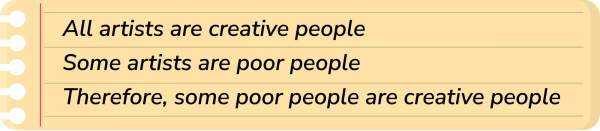
By speaking of two categories in every proposition, the sentence structure creates qualitative and quantitative relations between the subjects and predicates. These are important features for those who want to ...