Types of Scalability
Explore the different types of scalability in software architecture, including horizontal, vertical, and hybrid approaches. Understand their advantages and disadvantages to make informed decisions on how to efficiently handle increasing workloads and resource demands in software systems.
Overview
Recall that scalability in software architecture addresses a system’s ability to adapt to growing demands and increased workloads. There are several types of scalability that can be achieved in software architecture, including:
Horizontal scalability
Horizontal scalability involves adding more resources, such as servers or machines, to an existing system in order to increase its capacity and handle a larger workload. This approach is often used when the workload is distributed across multiple machines and can be easily distributed across additional machines as needed.

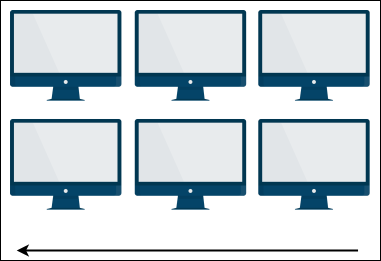
For example, a web application that receives a large number of requests can be scaled horizontally by adding more web servers to the system. This allows the application to handle the ...