CLOUD LABS
Building a CI/CD Pipeline in AWS Using Terraform
In this Cloud Lab, you’ll learn to create a complete CI/CD pipeline using CodeBuild, CodeDeploy, and CodePipeline through Terraform.
intermediate
Certificate of Completion
Learning Objectives
Terraform seamlessly integrates with the CI/CD workflow, streamlining the process of building, testing, and deploying applications. It is a tool that can provision infrastructure on your machine or any cloud provider, thus ensuring similar infrastructure anywhere possible.
In this Cloud Lab, you will learn about Terraform, why to choose Terraform for CI/CD, and how to manage Terraform code. Then, you’ll create an S3 bucket and security group and configure an IAM role for an EC2 instance using Terraform. You’ll then set up a GitHub repository, create a CodeBuild project, a CodeDeploy application and deployment group, and configure an entire CodePipeline using Terraform.
By the end of this Cloud Lab, you’ll become well-versed in creating and launching CI/CD pipelines through Terraform on AWS, an essential skill for any cloud architect. Using Terraform, teams can ensure that the underlying infrastructure is automatically provisioned and configured in alignment with the code changes.
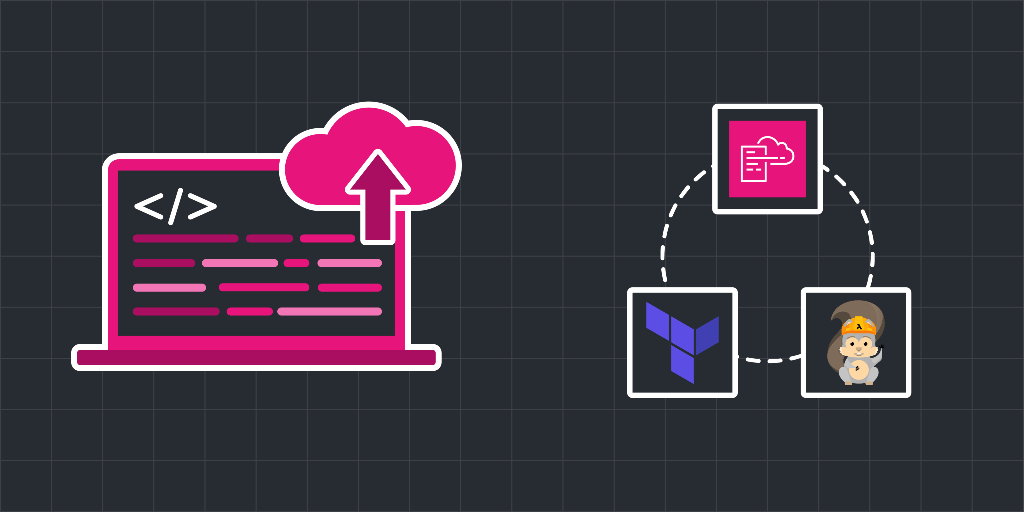
The following is the high-level architecture diagram of the infrastructure that you’ll create in this Cloud Lab:


Why CI/CD matters (even for small teams)
CI/CD(Continuous Integration and Continuous Delivery/Deployment) is the practice of automating how code is built, tested, and released. Without it, releases are often manual and inconsistent. With it, teams can ship faster with fewer surprises because every change follows the same repeatable path.
CI/CD helps you:
Catch issues earlier with automated tests.
Reduce deployment risk through consistent processes.
Improve collaboration through predictable release workflows.
Build confidence with traceable, auditable deployments.
Where Terraform fits into CI/CD
Terraform doesn’t replace CI/CD, it complements it. CI/CD moves application code through stages; Terraform manages the infrastructure those stages run on. Together, they help you automate both:
The delivery pipeline (build/test/deploy stages).
The infrastructure required to run that pipeline (permissions, artifacts, compute, networking).
When pipeline infrastructure is managed as code, it becomes:
Reproducible across environments
Reviewable via pull requests
Easier to audit and rollback
Less dependent on fragile manual configuration
The common “pipeline as a system” model
Most CI/CD pipelines on AWS follow a familiar pattern:
Source stage: A change is detected (often from a repo) and triggers the pipeline.
Build stage: The pipeline builds artifacts (binaries, containers) and runs tests or validation checks.
Artifact management: Build outputs are stored, so the same artifact can be promoted across environments.
Deploy stage: Artifacts are deployed to a target runtime (VMs, containers, serverless). Higher maturity setups include approvals and progressive rollout strategies.
The exact services vary, but the workflow is consistent.
What makes CI/CD pipelines reliable in production
A “working pipeline” isn’t the same as a dependable one. Reliable pipelines usually include:
Clear separation between environments (dev/staging/prod).
Least-privilege IAM permissions.
Secure secrets handling (no hardcoded credentials).
Rollback options and deployment safety checks.
Observability: logs, metrics, and notifications.
Policies and guardrails (linting, scanning, approvals).
How teams evolve CI/CD over time
Teams typically start with a simple pipeline that builds and deploys. Over time, they add:
Test suites and quality gates.
Security scanning (dependencies, images).
Infrastructure testing and policy checks.
GitOps-style deployment models.
Progressive delivery (canary/blue-green).
Automated environment provisioning and teardown for preview environments.
Learning the fundamentals first makes those improvements easier to adopt.
Before you start...
Try these optional labs before starting this lab.

Relevant Courses
Use the following content to review prerequisites or explore specific concepts in detail.
Felipe Matheus
Software Engineer
Adina Ong
Senior Engineering Manager
Clifford Fajardo
Senior Software Engineer
Thomas Chang
Software Engineer
