Other Common Asymptotic Notations and Why Big O Trumps Them
Learn to differentiate between Big Omega, Big Theta, Little o, and Little Omega notations and understand why Big O notation is commonly preferred for analyzing worst-case algorithm complexity. This lesson equips you with practical insights into applying these notations effectively in coding interviews and algorithm analysis.
Big Omega:
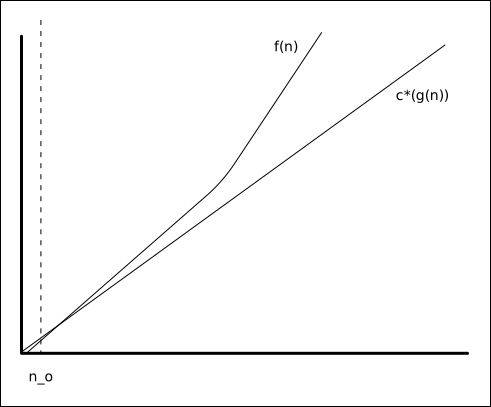
Mathematically, a function is in if there exists a real constant and there exists such that for . In other words, for sufficiently large values of , will grow at least as fast as .
Note: It is a common misconception that Big O characterizes the worst-case running time while Big Omega characterizes the best-case running time of an algorithm. There is no one-to-one relationship between any of the cases and the asymptotic notations.
The following graph shows an example of functions ...

Quick quiz on Big Omega!
(True or False) .
True
False
...