Essential Dart libraries include HTTP for RESTful API integration, provider for state management, and intl for localization and internationalization. These libraries improve app responsiveness and user experience. Explore libraries like rxdart for reactive programming and flutter_bloc for advanced state management to further expand your skills.
Table of Contents
Top 7 Dart tips and tricks for cleaner Flutter apps
5 mins read
Mar 05, 2025
Share
Dart is a client-optimized programming language for quickly building mobile, desktop, and server apps. Google developed it to be used with its cross-platform Flutter framework. With Flutter and Dart, you can build apps with a slick UI and a native feel.
This blog will provide you with the top 7 Dart tips to help you improve your app development. You can use these tips to write concise code and take advantage of Dart’s many features.
Tips and tricks at a glance#
Use anonymous functions as arguments.
Make Dart classes callable with the
callmethod.Use
.entriesto iterate through a map.Use getters and setters to provide controlled access to your data.
Use Dart sets for managing collections of unique items.
Utilize Flutter’s inspect widget for better UI debugging.
Use sync and async generators.
Use anonymous functions as arguments#
In the Dart language, functions can be passed as arguments to other functions. Dart provides anonymous functions that do not need a name and can be used directly. To learn more about Dart, you can look at the course Developing Web Applications with Dart.
Below is an example of an anonymous function in Dart. Here, we pass an anonymous cube function to a built-in method, forEach, to get the cube for every item in a list.
We can also pass anonymous functions as arguments to other functions. This approach to your code is useful when you use functional operators (like map, reduce, or where).
Below is an example of defining and assigning an anonymous function to a variable.
sayHello is passed to the intro function, which takes the Function argument. On line 6, String Function(String) is a function type that returns a string from a given string argument. Our anonymous function has the same signature, which is passed as an argument.
Make Dart classes callable with the call method#
With Dart, you can create a callable class that allows that class instance to be called as a function. We do this with the call() method. See the syntax below:
Let’s see this in action with an example.
Note: Dart doesn’t support multiple callable methods.
Use .entries to iterate through a map#
In Dart, can you iterate through a map in a null-safe manner using entries? Say we have a map that tracks the amount spent on different products. Typically, we’d iterate through this map with the ! operator.
We can improve this code by using a loop and making it more null-safe. When we iterate with the entires variable, we can access our key-value pairs in a null-safe manner.
Get up to date with Dart
Learn Dart and its updates without scrubbing through videos or documentation. Educative’s text-based courses are easy to skim and feature live coding environments, making learning quick and efficient.
Use getters and setters to provide controlled access to your data#
Getters and setters are special methods that provide read and write access to an object’s properties. Getters and setters are similar to instance variables: a dot operator (.) is simply followed by the function name.
Getters are functions that retrieve the values of an object’s properties. We use the get keyword.
Below is an example where we create a getter function on line 13 that will return the value of the current instance’s name. On line 21, we call the getter function, and the output should display Sarah.
Setters are functions used to write the values of an object’s properties. We use the set keyword.
On lines 9–15, we create a setter function that sets the value for age. We also give it a condition so we cannot input a negative age. On line 23, we set the age value for firstPerson using the personAge setter function.
Use Dart sets for managing collections of unique items#
A list is one of Dart’s most common collection types, but lists can hold duplicate items. Sometimes, we want only a collection of unique values. This is where a Set is useful.
Two elements cannot be equal in a set, so the code above will offer a warning and not compile. This is also true if we use a const set.
Utilize Flutter’s inspect widget for better UI debugging#
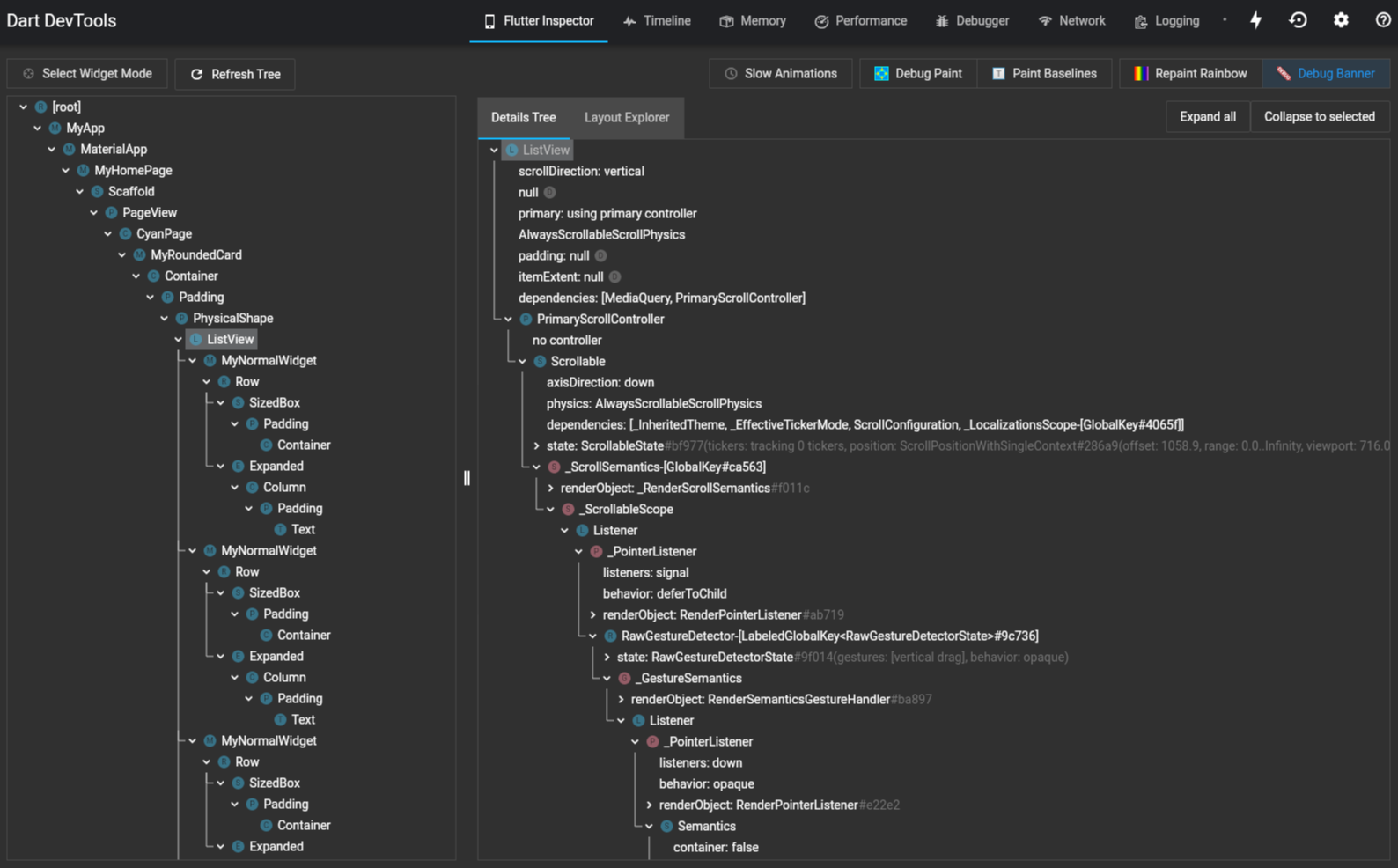
In web development, the inspect element commonly tells you all the properties applied to an HTML tag. Dart provides a similar feature called the Inspect Widget that can make app development with Flutter easier. The Flutter Widget Inspector can locate any widget on the screen and view its properties.
The inspector can also help you visualize Flutter widget trees to understand layouts or identify layout issues.
To use it, follow the steps below:
Click the “Flutter inspector” button.
Click the “Enable Select Widget Mode” button.
Select a widget on the screen to get more information on it.
Source: Flutter documentation
Use sync and async generators#
In Dart, generators make it possible to produce a sequence of values. There are two generator functions:
Synchronous generator: Returns an iterable object
Asynchronous generator: Returns a Stream object
In other words, the synchronous generator returns a collection of values that can be accessed sequentially. We do this by marking the function body as sync*. Then, we use yield statements for the values.
The asynchronous generator, on the other hand, returns a Stream object. A Stream allows us to receive a sequence of events. We do this by marking the function body as async*. Then, we use yield statements for the values.
Recap and next steps#
We hope these tips help you make the most of Dart and all the features it offers. Flutter and Dart are a powerful pair for building apps that feel native and slick. Other advanced Dart tools to investigate next are:
Spread operators for nested if-statements
Named constructors and initializer lists
Dart libraries
Enumerated types
Check out the Educative course Developing Web Applications with Dart to get hands-on practice with Dart and learn its new features. You will dive deep into Dart 2 language features and become confident with Dart extensions, enums, mixins, generics, libraries, and more.
Happy learning!
Continue learning about Dart and app development#
Frequently Asked Questions
What are the best libraries for Dart app development?
What are the best libraries for Dart app development?
What real-world applications are built using Dart and Flutter?
What real-world applications are built using Dart and Flutter?
What resources can help me learn Dart and Flutter together?
What resources can help me learn Dart and Flutter together?
Written By:
Tehreem Arshad
Related Courses
Swift Programming for Mobile App DevelopmentCreating Long-Lived Web Apps with Ruby on RailsModern Android App Development with JavaMastering Mobile Application Development with IonicModern Android App Development with KotlinBuild Robust Applications with Test-driven Development in DjangoBeginning Flutter: Android Mobile App DevelopmentEffective Software Development for Enterprise ApplicationsBuilding Applications with React NativeMaster Ethereum Development: From Beginner to Dapp DeveloperGetting Started with Mobile App Development with React NativeNext.js - The ultimate way to build React appsA Front-End Web Developer’s Guide to TestingDocker for Web DevelopersMaster Modern Django Admin: Customization and Architecture
