Do UX designers need to learn coding?
Thinking about a UX career but unsure about coding? Learn when coding actually matters, how designers collaborate with developers, and how to build strong UX skills without getting stuck in unnecessary programming.

Many people who are exploring careers in design eventually encounter an important question: Do UX designers need to learn coding? The question often arises because modern digital product teams typically include designers, developers, product managers, and researchers working closely together. When observing this collaboration, new designers sometimes wonder whether they must develop programming skills in order to succeed in the field.
User experience design focuses primarily on understanding user behavior, improving usability, and designing interfaces that help people accomplish tasks efficiently. UX designers conduct research, create wireframes, build prototypes, and test designs with real users. These responsibilities emphasize understanding human interaction with technology rather than implementing software systems.
However, because UX designers work closely with frontend developers who build the actual interfaces, technical awareness can sometimes strengthen collaboration. While coding is not a strict requirement for most UX roles, understanding how interfaces are implemented can help designers create more practical and technically feasible solutions.
Grokking the Coding Interview Patterns Cover
I created Grokking the Coding Interview because I watched too many talented engineers fail interviews they should have passed. At Microsoft and Meta, I saw firsthand what separated the candidates who succeeded from the ones who didn't. It wasn't how many LeetCode problems they'd solved. It was whether they could look at an unfamiliar problem and know how to approach it the right way. That's what this course teaches. Rather than throwing hundreds of disconnected problems at you, we organize the entire coding interview around 28 fundamental patterns. Each pattern is a reusable strategy. Once you understand two pointers, for example, you can apply them to dozens of problems you've never seen before. The course walks you through each pattern step by step, starting with the intuition behind it, then building through increasingly complex applications. As with every course on Educative, you will practice in a hands-on way with 500+ challenges, 17 mock interviews, and detailed explanations for every solution. The course is available in Python, Java, JavaScript, Go, C++, and C#, so you can prep in the language you'll actually use in your interview. Whether you're preparing for your first FAANG loop or brushing up after a few years away from interviewing, this course will give you a repeatable framework for cracking the coding interview.
What UX designers typically do#
UX designers contribute to digital products by researching user needs, designing interfaces, and improving usability through iterative design.
UX Responsibility | Description |
User research | Understanding user needs through interviews and studies |
Wireframing | Creating low-fidelity layouts of user interfaces |
Prototyping | Building interactive prototypes to test ideas |
Usability testing | Evaluating how users interact with a product |
Design iteration | Refining designs based on feedback |
These responsibilities highlight that UX design focuses on understanding users and improving product usability. Designers often study how people interact with technology, identify pain points, and propose design solutions that make interfaces easier to use.
Because these tasks emphasize research, interaction design, and usability testing, most UX work takes place in design tools rather than programming environments. This distinction is important when considering whether coding is necessary for a UX career.
Why coding is not always required for UX designers#
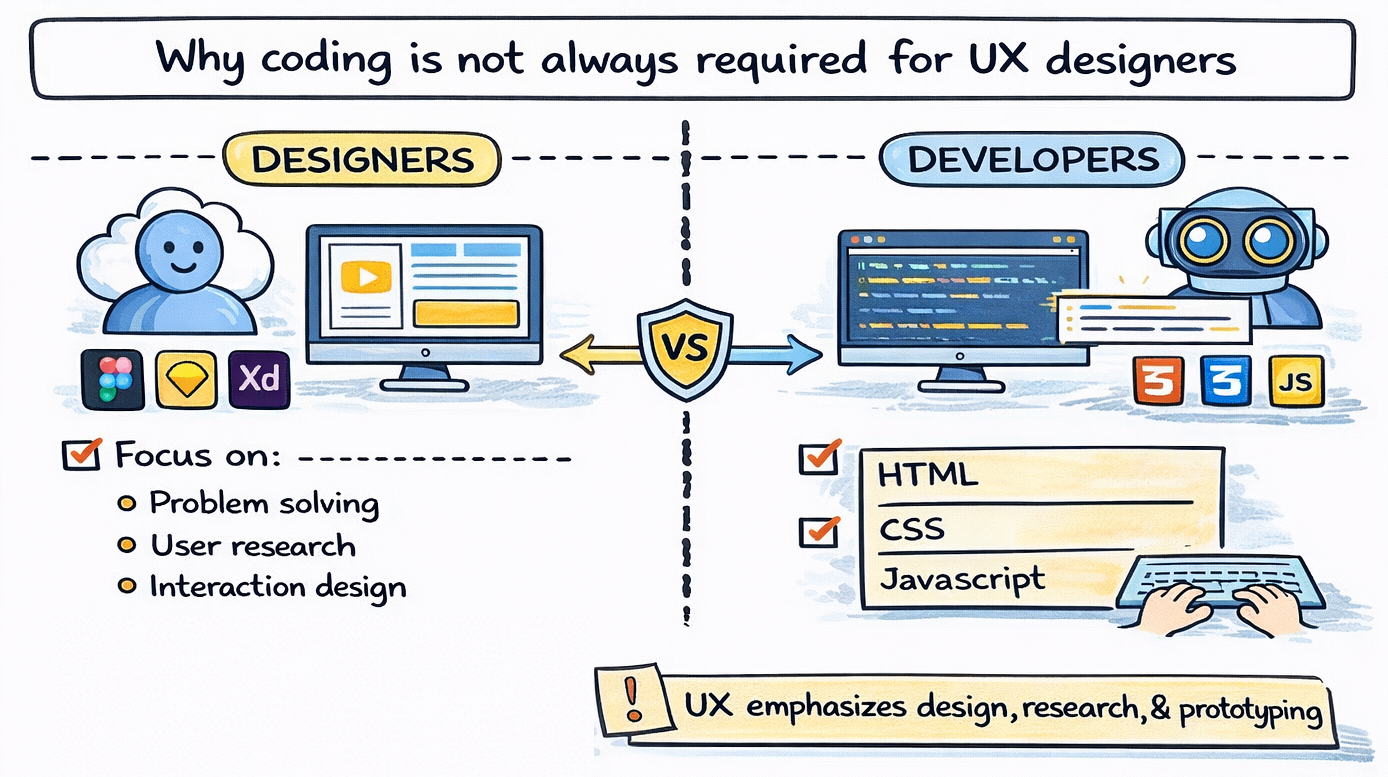
In most product teams, UX designers and developers have distinct responsibilities that complement one another. Designers focus on defining how a product should behave and how users should interact with it, while developers focus on implementing those designs in code.
Designers often create prototypes using tools such as Figma, Sketch, or Adobe XD. These tools allow designers to simulate user flows, interactive elements, and layout structures without writing production code. Once designs are finalized, frontend developers implement the interfaces using technologies such as HTML, CSS, and JavaScript.
Because of this division of responsibilities, many successful designers never write production-level code. For this reason, answering the question Do UX designers need to learn to code usually begins with understanding that UX design emphasizes problem solving, user research, and interaction design rather than software implementation.
Benefits of learning some coding as a UX designer#
Although coding is not required for most UX positions, learning basic programming concepts can offer several advantages.
Understanding how designs become real interfaces#
Designers who understand the fundamentals of HTML and CSS can better visualize how their layouts translate into actual user interfaces. This awareness helps them design components that are easier for developers to implement.
Communicating more effectively with frontend developers#
When designers understand basic technical terminology, communication with developers becomes more productive. Designers can discuss layout constraints, browser behavior, and implementation details more clearly.
Designing components that are technically feasible#
Designers sometimes propose interactions or layouts that are difficult to implement efficiently. A basic understanding of frontend development helps designers recognize these limitations and create more practical design solutions.
Understanding browser behavior and layout systems#
Knowledge of browser rendering, responsive layouts, and interface constraints helps designers anticipate how designs will behave across different devices and screen sizes.
These advantages illustrate why some designers choose to explore coding after asking themselves Do UX designers need to learn coding in order to collaborate effectively with development teams.
UX design vs frontend development#
UX designers and frontend developers share responsibility for creating user interfaces, but their roles focus on different aspects of the product development process.
Role | Focus | Key Skills |
UX Designer | User experience and interaction design | Research, wireframes, usability |
Frontend Developer | Implementing user interfaces | HTML, CSS, JavaScript |
UX designers focus on identifying user needs, designing interface structures, and improving usability. Frontend developers translate these design concepts into working applications by writing code that runs in web browsers.
Although these roles require different skill sets, successful product teams depend on strong collaboration between designers and developers.
Coding skills that can benefit UX designers#
Designers who want to strengthen their technical understanding often begin by learning basic frontend technologies.
HTML structure and semantic markup#
HTML defines the structure of web pages and user interfaces. Understanding semantic HTML helps designers create layouts that support accessibility and maintainable code.
CSS layout systems#
CSS controls the visual presentation of web interfaces. Learning layout techniques such as Flexbox and Grid helps designers understand how elements adapt to different screen sizes and device types.
Basic JavaScript concepts#
JavaScript adds interactivity to web interfaces. Designers who understand basic JavaScript concepts can better anticipate how user interactions, animations, and dynamic content behave within applications.
Although mastering these technologies is not necessary for most UX roles, familiarity with them can improve communication and design decisions.
When coding knowledge becomes more valuable#
There are certain situations where coding knowledge becomes particularly useful for designers.
In small startup teams, designers often work closely with developers and may contribute to prototype implementation or basic interface development.
Coding knowledge is also helpful when building interactive prototypes that simulate real application behavior. Some designers use tools or frameworks that allow prototypes to behave more like actual applications.
Finally, hybrid roles such as UX engineer or design technologist combine design expertise with frontend development skills. Professionals in these roles often bridge the gap between design and engineering teams.
These situations demonstrate that while coding is not required for every designer, technical knowledge can expand career opportunities and collaboration possibilities.
FAQ#
Should beginner UX designers learn coding?#
Beginner UX designers typically benefit more from focusing on design fundamentals such as user research, interaction design, and usability testing. Once those core skills are established, learning basic coding concepts can enhance collaboration with developers.
What programming language is most useful for UX designers?#
For designers who want to explore coding, HTML, CSS, and basic JavaScript provide the most relevant technical knowledge because they form the foundation of frontend development and interface implementation.
Is coding required to get a UX design job?#
Coding is generally not required for most UX design roles. Employers typically evaluate design thinking, research ability, and portfolio projects rather than programming skills.
Can UX designers transition into frontend development?#
Yes, some designers transition into frontend development by learning programming languages and development frameworks. Designers who already understand user interface principles often adapt well to frontend engineering roles.
Conclusion#
UX design and frontend development are closely related but distinct disciplines within digital product teams. UX designers focus primarily on understanding users, improving usability, and designing intuitive interfaces, while developers implement those designs using programming languages and frameworks.
Understanding whether UX designers need to learn coding helps clarify that programming skills are not a requirement for most UX careers. However, learning basic technical concepts can strengthen collaboration with developers and provide valuable insight into how designs become working products.
