What is the easiest coding language to learn?
Not sure which programming language to start with? Learn what makes a language beginner-friendly, compare top options like Python and JavaScript, and follow practical tips to build real coding skills faster. Start your coding journey today.
Many people who are curious about programming begin their journey by searching for the easiest coding language to learn. The world of software development includes dozens of programming languages, each designed for different types of applications and industries. For beginners, this variety can feel overwhelming because it is not immediately clear where to begin.
Selecting a beginner-friendly programming language can significantly influence how quickly someone learns coding concepts. When a language is approachable and supported by strong learning resources, beginners can focus more on problem-solving and less on complicated syntax. While there is no single universal answer to which language is easiest, understanding how programming languages differ can help learners choose a starting point that aligns with their goals.
Grokking the Coding Interview Patterns
I created Grokking the Coding Interview because I watched too many talented engineers fail interviews they should have passed. At Microsoft and Meta, I saw firsthand what separated the candidates who succeeded from the ones who didn't. It wasn't how many LeetCode problems they'd solved. It was whether they could look at an unfamiliar problem and know how to approach it the right way. That's what this course teaches. Rather than throwing hundreds of disconnected problems at you, we organize the entire coding interview around 28 fundamental patterns. Each pattern is a reusable strategy. Once you understand two pointers, for example, you can apply them to dozens of problems you've never seen before. The course walks you through each pattern step by step, starting with the intuition behind it, then building through increasingly complex applications. As with every course on Educative, you will practice in a hands-on way with 500+ challenges, 17 mock interviews, and detailed explanations for every solution. The course is available in Python, Java, JavaScript, Go, C++, and C#, so you can prep in the language you'll actually use in your interview. Whether you're preparing for your first FAANG loop or brushing up after a few years away from interviewing, this course will give you a repeatable framework for cracking the coding interview.
What makes a programming language easy to learn?#
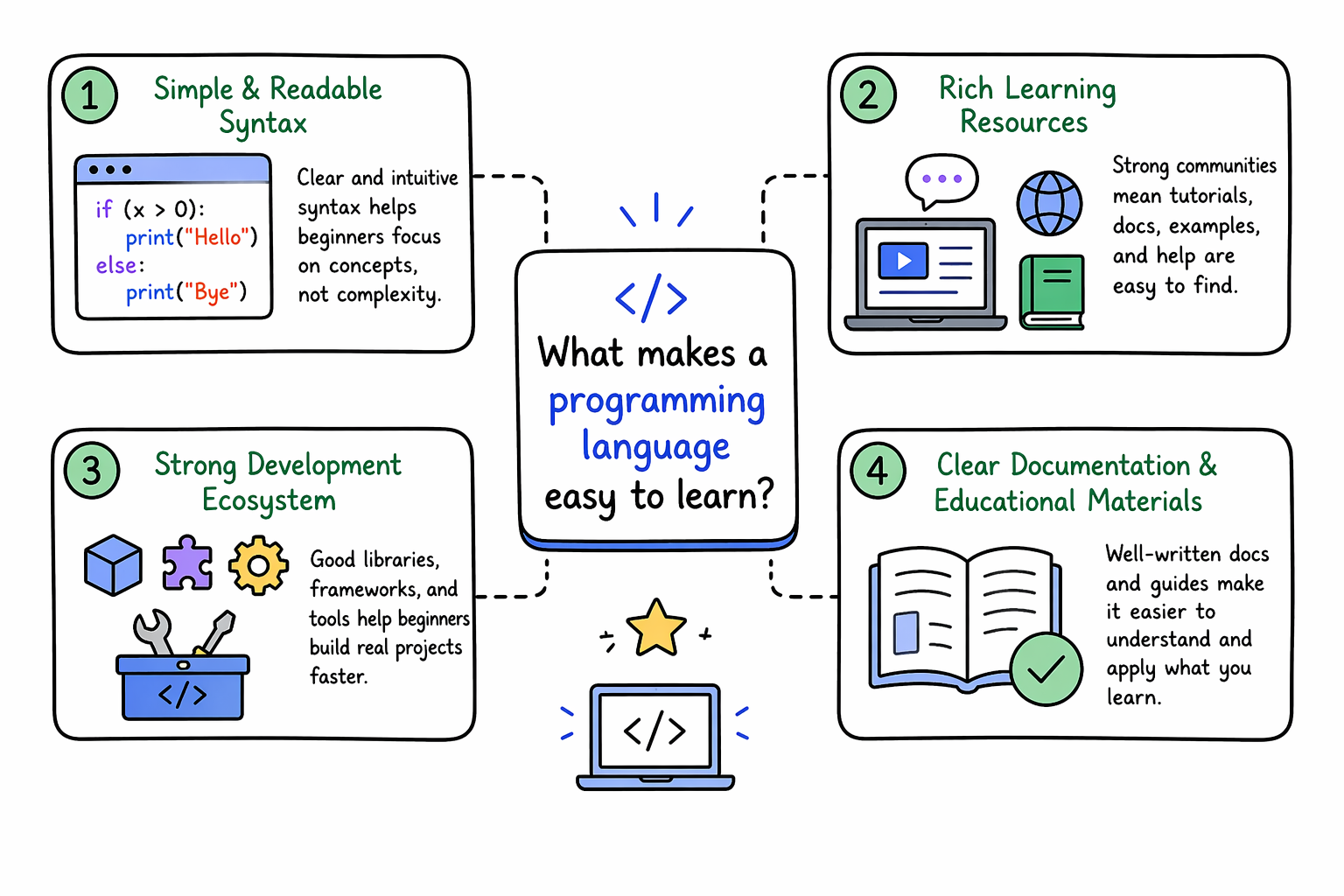
The difficulty of learning a programming language often depends on several characteristics that influence how accessible the language is for beginners.
One important factor is syntax readability. Programming languages with simple and human-readable syntax allow learners to understand code more easily. When commands resemble natural language or logical instructions, beginners spend less time struggling with formatting rules and more time learning programming concepts.
Another factor is the availability of learning resources. Languages supported by large communities usually have extensive tutorials, documentation, and example projects. Beginners benefit greatly from having access to guides, online courses, and discussion forums where they can ask questions.
A strong development ecosystem also helps reduce the learning curve. Languages that offer beginner-friendly libraries, frameworks, and development tools allow new programmers to build useful projects early in their learning process.
Finally, clear documentation and educational materials play a major role. Well-written documentation allows beginners to understand how features work and how to apply them in real projects.
These characteristics explain why some languages are commonly recommended as the easiest coding language to practice for people who are just beginning their programming journey.
Comparison of beginner-friendly programming languages#
Several programming languages are widely recognized for being approachable for beginners.
Language | Key Advantages | Typical Use Cases |
Python | Simple syntax and large ecosystem | Data science, web development |
JavaScript | Runs directly in browsers | Web development |
Ruby | Clean and readable syntax | Web applications |
Scratch | Visual programming blocks | Teaching programming basics |
Each of these languages helps beginners understand fundamental programming concepts such as variables, conditions, loops, and functions.
Python focuses on readability and simplicity, which allows learners to write meaningful programs quickly. JavaScript allows developers to build interactive websites and see results directly in a web browser. Ruby emphasizes clean syntax that resembles natural language, making it easier for beginners to understand program logic. Scratch takes a visual approach, using blocks instead of text-based code to introduce programming principles.
For beginners deciding on the easiest coding language to learn, this comparison demonstrates that the best choice often depends on personal learning goals.
Python: one of the easiest coding languages for beginners#
Python is frequently recommended as the easiest coding language to learn because of its straightforward syntax and broad ecosystem.
The language emphasizes readability, which means that code often looks similar to plain English instructions. Beginners can quickly understand what a program is doing without needing to memorize complex syntax rules. This design allows learners to focus on understanding algorithms and problem-solving strategies.
Python is also used across many domains, including data science, machine learning, automation, and web development. Because of this versatility, beginners who learn Python gain access to a wide range of career paths and projects.
Another advantage of Python is its large community. Developers around the world contribute tutorials, open-source libraries, and discussion forums that help beginners find solutions to common problems.
Data Structures for Coding Interviews in Python
Data structures are amongst the most fundamental concepts of Computer Science. The data structure chosen can make or break an entire computer program. Consequently, they are also largely categorized as a vital benchmark of computer science knowledge when it comes to industry interviews. This course contains a detailed review of all the common data structures and provides implementation level details in Python to allow readers to become well equipped. Now with more code solutions, lessons, and illustrations than ever, this is the course for you!
JavaScript: learning programming through web development#
JavaScript offers another attractive option for beginners who want to build interactive applications on the web.
One of the most appealing aspects of JavaScript is that it runs directly in web browsers. This capability allows beginners to experiment with code and immediately see the results on a webpage. For many learners, this visual feedback makes programming more engaging.
JavaScript also powers modern frontend frameworks such as React, Vue, and Angular. These technologies enable developers to build complex web applications and interactive user interfaces. Because the web is such a central part of modern computing, JavaScript remains one of the most widely used programming languages.
For learners interested in web development, JavaScript may become the easiest coding language to learn because it allows them to create visible projects early in the learning process.
Decode the Coding Interview in JavaScript: Real-World Examples

Preparing for coding interviews has become a daunting task. Trying to solve enough practice questions and remember solutions can feel impossible. Fortunately, the best way to be successful in the coding interview is not to just grind through problems. The best way is to develop the skills to break down a new problem and deploy the right tools to come up with a solution. That’s why in this course, you’ll prepare for coding interviews by tackling real-world problems faced by tech companies. When you solve real problems related to real projects (for example, paginating attendees in a Zoom call), not only will you have more fun preparing, but you’ll also have an easier time remembering what you’ve learned. After each project, we’ll also show you what kinds of interview problems you’ll now be able to solve using the techniques you just applied so that your knowledge is adaptable to new problems. (This course is also available in Rust, Java, C++, C#, Go, Python, Ruby, Elixir, Scala, Swift, and Kotlin.)
Other beginner-friendly languages#
In addition to Python and JavaScript, several other languages provide approachable learning experiences for beginners.
Ruby is known for its clean syntax and emphasis on developer productivity. Many learners find Ruby programs easy to read because the language was designed to resemble natural language patterns.
Scratch is often used in educational settings to introduce programming concepts to younger students. Instead of writing code, learners assemble visual blocks that represent instructions. This visual approach helps beginners understand logical thinking and program flow without worrying about syntax errors.
Choosing among these options depends largely on the type of applications learners want to build and the environment in which they plan to use their programming skills.
How beginners should approach learning programming#
Choosing the easiest coding language to learn is only the first step in the journey toward becoming comfortable with programming.
One effective strategy is to practice coding exercises regularly. Small challenges help learners apply concepts such as loops, conditional statements, and functions in practical situations.
Building simple projects is another powerful learning technique. Projects such as calculators, small games, or task management applications allow beginners to combine multiple programming concepts into a working program.
Reading other developers’ code can also accelerate learning. Observing how experienced programmers structure their solutions helps beginners understand coding patterns and best practices.
Participating in programming communities provides additional support. Online forums, developer groups, and open-source projects allow beginners to ask questions and learn from others who are further along in their programming journey.
Common mistakes beginners make#
Beginners often encounter challenges that slow their learning progress.
One common mistake is trying to learn multiple programming languages at the same time. Because each language has its own syntax and conventions, switching between them too early can create confusion. Focusing on one language helps learners build stronger foundational skills.
Another challenge is focusing too heavily on memorizing syntax instead of understanding programming concepts. Concepts such as problem decomposition, algorithms, and debugging are more valuable in the long term than memorizing individual commands.
Beginners may also feel discouraged when encountering errors in their code. Debugging is a natural part of programming, and learning how to identify and correct mistakes is an essential skill.
Understanding these challenges helps learners stay motivated and progress steadily.
FAQ#
Is Python always the easiest coding language to learn?#
Python is often recommended for beginners because of its readable syntax and extensive learning resources. However, the easiest coding language to learn may vary depending on individual goals. Someone interested in web development might find JavaScript easier to start with because it allows them to build browser-based projects immediately.
How long does it take to learn a programming language?#
The time required to learn a programming language depends on factors such as practice frequency, prior experience with logical thinking, and the complexity of the projects being built. Many beginners become comfortable with basic programming concepts after several months of consistent practice.
Should beginners learn multiple languages at once?#
Learning multiple languages simultaneously can slow progress for beginners because each language introduces new syntax and conventions. Focusing on a single language first allows learners to develop strong programming fundamentals before exploring additional technologies.
Do I need a computer science degree to learn programming?#
A formal computer science degree is not required to learn programming. Many developers teach themselves through online courses, tutorials, and personal projects. Consistent practice and curiosity often play a more important role in developing programming skills than formal academic credentials.
Final words#
Programming can appear intimidating at first, especially for beginners who encounter a wide range of languages and development paths. Understanding what makes a language approachable helps learners choose a starting point that aligns with their goals and interests.
While there is no universally easiest coding language to learn for everyone, languages such as Python, JavaScript, Ruby, and Scratch provide accessible entry points for beginners. By selecting a language that matches their interests and practicing consistently, learners can gradually develop the skills and confidence needed to explore the broader world of programming.
