Inventory management is one of the most underestimated System Design interview problems. At first glance, it sounds mechanical: track stock, update counts, prevent overselling. Many engineers have implemented something that looks like inventory at some point in their careers, often as a simple database table with a numeric column.
That familiarity is precisely why it is such a powerful interview signal. At scale, inventory stops being a number and becomes distributed, contested state. It is updated concurrently from multiple systems, read under extreme load, and treated as authoritative by ordering, fulfillment, finance, and analytics. When inventory drifts, the business feels it immediately—either through overselling, stockouts, delayed shipments, or reconciliation nightmares.
At mid-level, interviewers are satisfied if you identify reservations, concurrency, and consistency trade-offs. At senior level, the expectation rises. You are being evaluated on whether you understand that inventory is evolving state with a lifecycle, not a counter. You are being tested on your ability to reason about race conditions, multi-location coordination, operational drift, and failure containment. Distributed state and concurrency are the real test.
Inventory systems rarely fail loudly. They decay silently until the business notices.
That silent decay—inventory drift—is what separates naive designs from production-grade systems.

For a decade, when developers talked about how to prepare for System Design Interviews, the answer was always Grokking System Design. This is that course — updated for the current tech landscape. As AI handles more of the routine work, engineers at every level are expected to operate with the architectural fluency that used to belong to Staff engineers. That's why System Design Interviews still determine starting level and compensation, and the bar keeps rising. I built this course from my experience building global-scale distributed systems at Microsoft and Meta — and from interviewing hundreds of candidates at both companies. The failure pattern I kept seeing wasn't a lack of technical knowledge. Even strong coders would hit a wall, because System Design Interviews don't test what you can build; they test whether you can reason through an ambiguous problem, communicate ideas clearly, and defend trade-offs in real time (all skills that matter more than ever now in the AI era). RESHADED is the framework I developed to fix that: a repeatable 45-minute roadmap through any open-ended System Design problem. The course covers the distributed systems fundamentals that appear in every interview – databases, caches, load balancers, CDNs, messaging queues, and more – then applies them across 13+ real-world case studies: YouTube, WhatsApp, Uber, Twitter, Google Maps, and modern systems like ChatGPT and AI/ML infrastructure. Then put your knowledge to the test with AI Mock Interviews designed to simulate the real interview experience. Hundreds of thousands of candidates have already used this course to land SWE, TPM, and EM roles at top companies. If you're serious about acing your next System Design Interview, this is the best place to start.
Framing the problem at scale#
Before designing schemas or APIs, the right move is to frame the system. Inventory requirements vary dramatically depending on context. A single-warehouse internal tracking tool behaves differently from a global e-commerce platform serving millions of concurrent shoppers.
At scale, inventory systems must answer several questions:
Is the source of truth centralized or per location?
How strict must correctness be during checkout?
Is inventory reserved during payment or only after order confirmation?
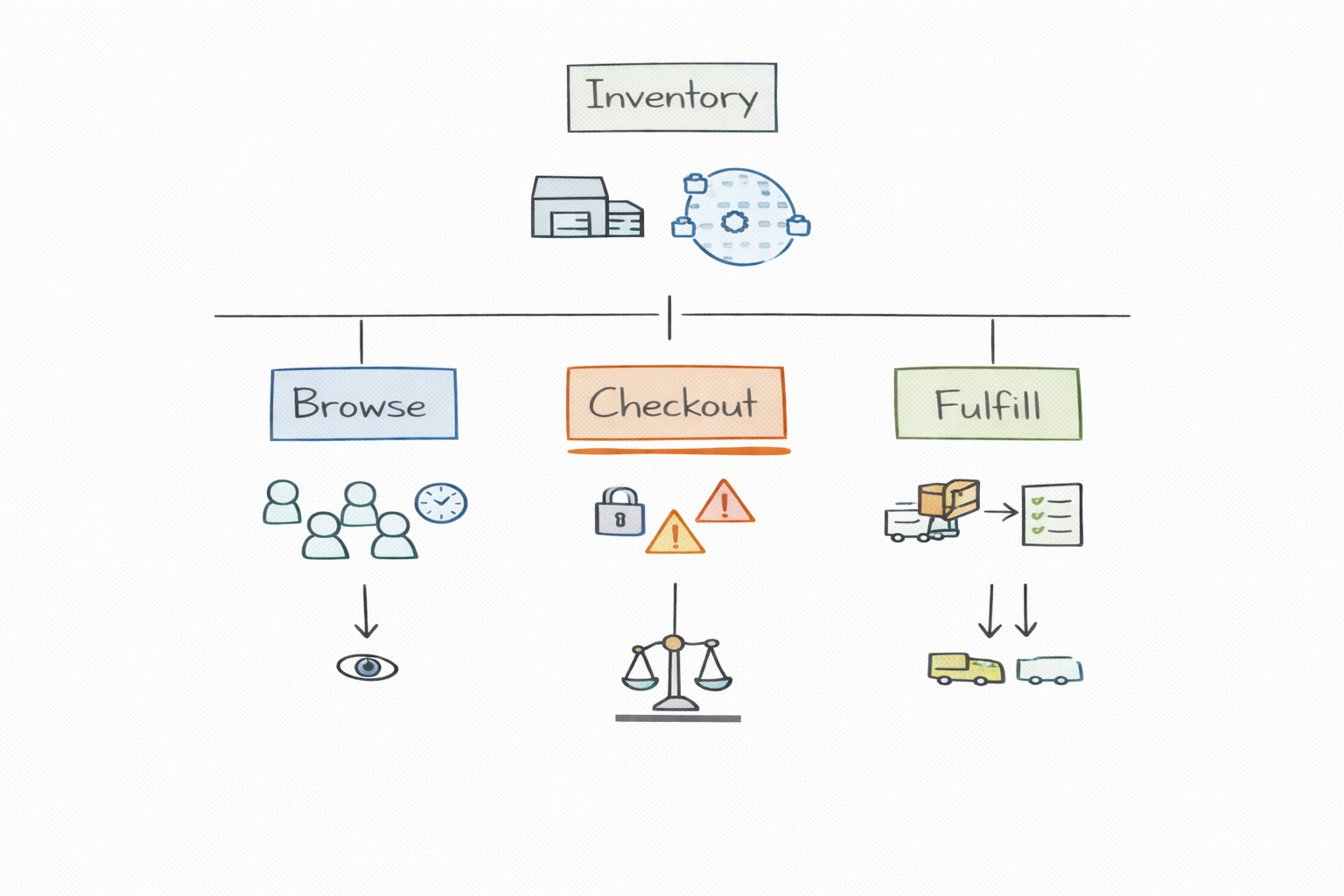
Inventory flows do not share identical priorities. Browsing can tolerate slightly stale data. Checkout cannot tolerate overselling. Fulfillment requires operational correctness and traceability.
The distinction becomes clearer when you lay out priorities explicitly.
Flow | Primary priority | Why |
Browsing | Availability | Slight staleness acceptable |
Checkout | Consistency | Prevent overselling |
Fulfillment | Correctness | Operational and financial trust |
Understanding that different flows optimize for different system properties is a senior-level signal. Inventory design is not about enforcing one global consistency model; it is about applying the right guarantees at the right time.
What strong candidates do differently#
Strong candidates do not describe inventory as “a table with stock counts.” They describe it as layered, evolving state.
Instead of asking, “How do we decrement inventory?” they ask, “What states does inventory move through?” Instead of assuming inventory is modified in one place, they recognize that multiple services—checkout, fulfillment, returns, transfers—will all attempt to mutate it.
They narrate the lifecycle before designing storage. They differentiate between reserved, allocated, fulfilled, returned, damaged, and available states. They treat aggregated views (such as “total available across all warehouses”) as derived data, not the source of truth.
Strong candidates treat inventory as evolving state, not a static number.
That framing changes the entire conversation. It shifts the design from CRUD operations to state transitions and concurrency control.
End-to-end inventory lifecycle walkthrough#
The best way to design inventory is to walk through its lifecycle. Inventory does not begin and end with checkout. It flows through creation, reservation, allocation, fulfillment, return, and reconciliation.
Initial stock creation#
Inventory begins with stock creation—items arriving at a warehouse or being manufactured. At this stage, the system transitions from zero to available stock.
What can break? In multi-location systems, duplicate ingestion events or delayed confirmations can create mismatches between physical and digital inventory. A naive system assumes stock creation is rare and manual. A mature design anticipates automated ingestion pipelines and idempotent updates.
The dominant priority here is correctness. Incorrect initial counts propagate downstream into every other flow.
Reservation during checkout#
When a customer begins checkout, the system may reserve inventory. Reservation temporarily reduces sellable stock without committing it permanently.
What changes in state? Inventory moves from “available” to “reserved.”
What can break? Two customers attempt to reserve the same final unit concurrently. Without coordination, both succeed.
A naive system decrements immediately at checkout. A stronger design introduces reservation with expiration. If payment fails or the session times out, the reservation releases automatically.
Latency matters here, but consistency dominates. It is better to reject a request than oversell.
Order placement and allocation#
Once payment succeeds, inventory transitions from reserved to allocated. Allocation is stronger than reservation—it represents commitment to fulfill.
What can break? Payment succeeds but allocation fails due to a concurrent update. Without careful ordering and idempotency, allocation may be applied twice or not at all.
A naive design merges reservation and allocation. A stronger design treats them as separate states to allow for cancellation windows and operational flexibility.
Fulfillment deduction#
Inventory may not be physically deducted until fulfillment begins. This allows for cancellations before picking.
What changes in state? Allocated inventory transitions to fulfilled.
What can break? Fulfillment services retry messages. If deduction is not idempotent, inventory drops twice.
Correctness dominates. Once inventory leaves the warehouse, state must reflect physical reality.
Cancellation and returns#
Cancellations and returns introduce reverse transitions.
Returned items are not always immediately sellable. Some require inspection; some are damaged.
A naive design increments stock immediately on return. A realistic system tracks intermediate states such as “returned pending inspection.”
Inventory state evolves; it does not toggle between zero and one.
Returns also introduce reconciliation challenges. What if a return event is processed twice? Idempotency becomes critical again.
Audits and reconciliation#
No inventory system is perfectly accurate forever. Periodic audits compare physical counts with digital state.
What changes in state? Manual corrections adjust discrepancies.
What can break? Silent drift due to lost updates or race conditions. If reconciliation workflows are not built in, errors accumulate.
Reconciliation systems must preserve audit logs and explain how state changed over time. Senior interviewers listen for awareness of drift detection.
Modeling inventory as layered state#
Inventory is rarely a single number. It is often layered by SKU, location, state, and time.
Granular updates typically occur at the lowest level (SKU per location), while reads often request aggregated views.
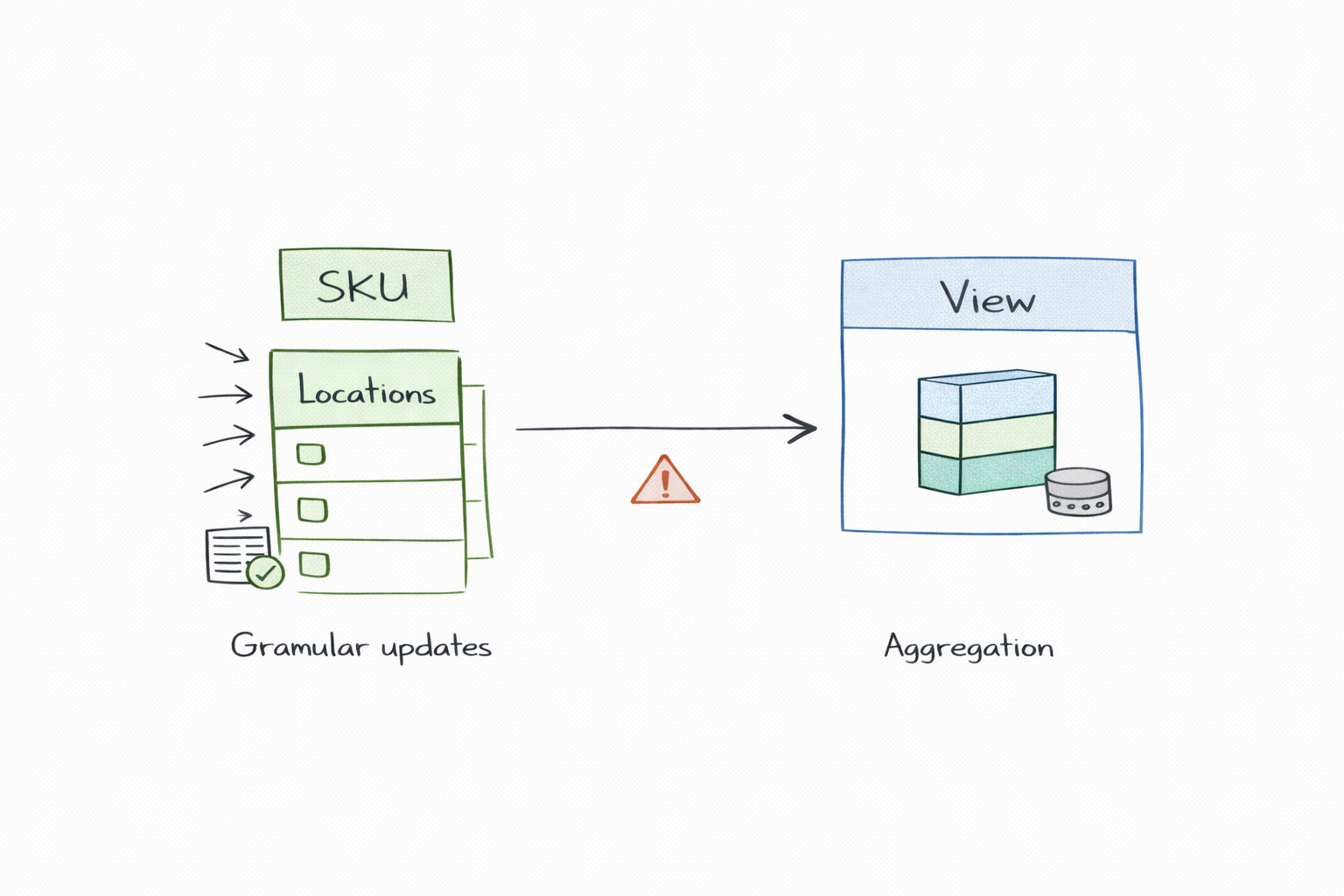
Confusing aggregated views with source-of-truth data is a common mistake. If an aggregated cache becomes authoritative, discrepancies become difficult to trace.
The right approach separates write paths (granular, authoritative) from read models (aggregated, possibly cached).
Reservation vs allocation deep dive#
Reservation and allocation represent different commitments.
Reservation prevents overselling during checkout but is temporary. Allocation commits stock for fulfillment.
Reservation | Temporary hold | During checkout |
Allocation | Fulfillment commitment | After order confirmation |
The gain from reservation is oversell protection. The risk is inventory being locked unnecessarily. Mitigation comes from expiration policies and monitoring abandoned carts.
The gain from allocation is operational certainty. The risk is premature commitment if fulfillment cannot proceed. Mitigation includes delayed allocation until payment confirmation.
Concurrency and race conditions explained#
Concurrency is the heart of inventory complexity.
Imagine two warehouses updating the same SKU simultaneously.
Interviewer: “What happens if two warehouses decrement the same SKU at the same time?”
You: “If writes are not serialized logically, we risk lost updates. Each decrement must operate against a versioned or atomic state transition.”
Interviewer: “How do you prevent drift?”
You: “By ensuring updates are idempotent and using mechanisms that guarantee atomicity per SKU-location pair.”
Race conditions arise when multiple services attempt to mutate the same state concurrently. Lost updates occur when one write overwrites another. Logical ordering becomes more important than physical timing.
Strong consistency prevents drift but reduces availability under network partitions. Eventual consistency increases scalability but risks temporary overselling.
Strong consistency | Accurate stock | Reduced availability |
Eventual consistency | High scalability | Temporary inventory drift |
Mitigation strategies include reservation buffers, version checks, and reconciliation workflows.
Overselling prevention strategies#
Overselling is the most visible failure mode.
Interviewer: “Traffic spikes 5× during a sale. What breaks first?”
You: “Checkout reservations become contention points. Without proper coordination, concurrent reservations could oversell the last units.”
Interviewer: “What do you do?”
You: “We prioritize correctness at checkout and may reject or queue requests to avoid negative stock.”
During flash sales, write contention increases dramatically. Systems must protect consistency even if that means temporarily sacrificing throughput.
Multi-location and global inventory complexity#
Multi-location inventory introduces additional layers of complexity. Each warehouse maintains its own source of truth. Aggregated views combine them for user-facing queries.
Cross-region transfers create dual updates: decrement at source, increment at destination. If either side fails, stock drifts.
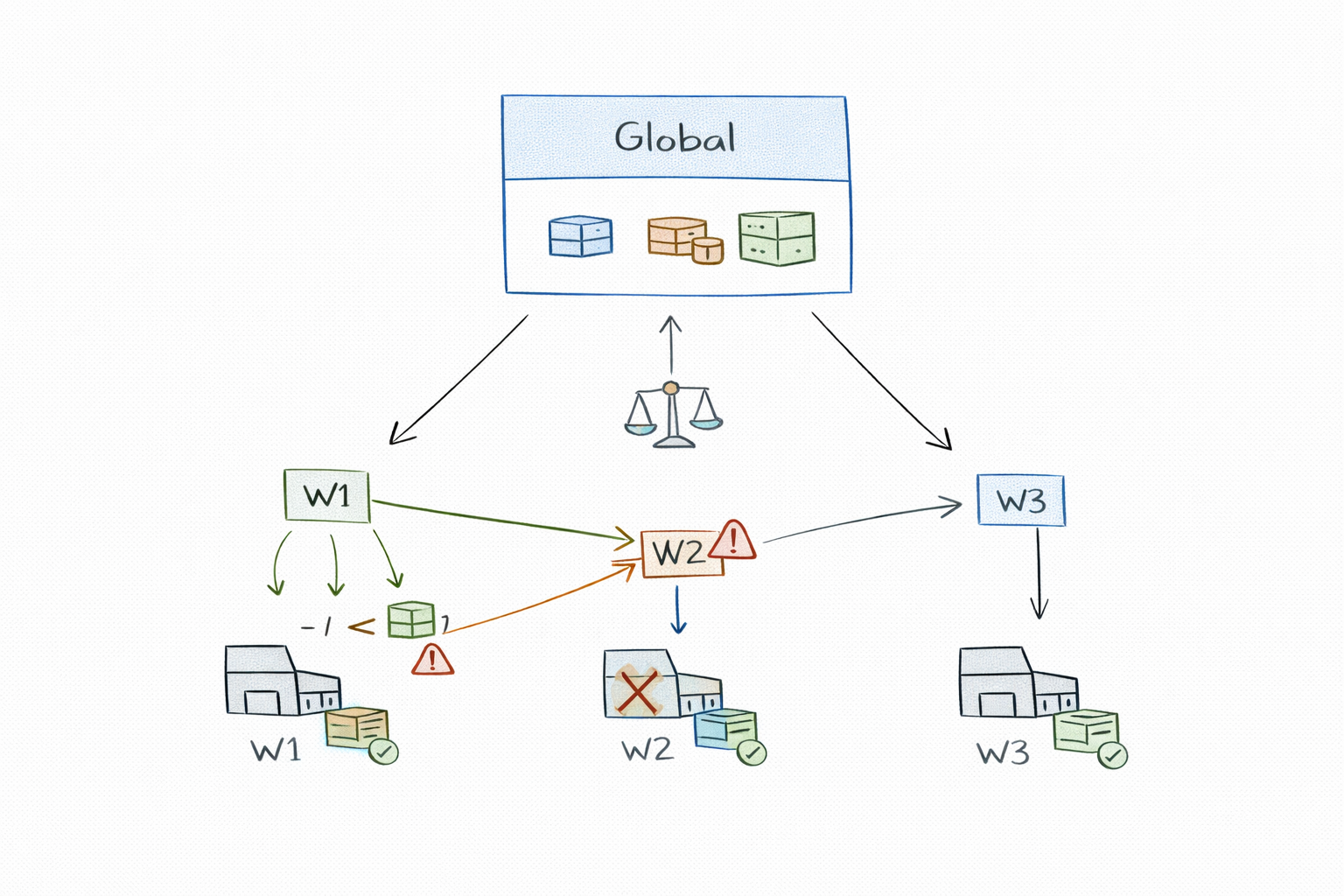
Regional failure isolation becomes critical. A warehouse outage should not corrupt global inventory state. Partitioning inventory by location reduces blast radius but increases reconciliation complexity.
Global inventory systems must decide whether aggregated views are strongly consistent or eventually consistent. Strong global consistency increases coordination overhead. Eventual consistency increases scalability but requires robust reconciliation.
Observability and operational safeguards#
Inventory drift is rarely obvious in real time. It manifests as customer complaints or fulfillment errors.
Operational safeguards include monitoring negative stock, detecting abnormal reservation expiration rates, and tracking drift between aggregated and source-of-truth counts.
Audit logs should capture every state transition. Reconciliation workflows must support safe correction without hiding history.
Inventory systems rarely fail catastrophically. They fail gradually and invisibly.
Alerting on anomalies—such as rapid stock depletion or unexpected spikes in adjustments—helps catch issues early.
Capacity planning and back-of-the-envelope reasoning#
Senior candidates estimate.
Imagine 1 million SKUs, 50 warehouses, and a peak sale event with 20,000 checkouts per second. Each checkout may reserve multiple SKUs.
That implies high write contention on popular SKUs. It suggests partitioning by SKU and location. It suggests that reservation expiration and retry storms must be anticipated.
Latency targets at checkout might require sub-100 ms responses. That constraint limits cross-region coordination.
Back-of-the-envelope reasoning forces trade-offs. If coordination latency exceeds acceptable thresholds, you may need per-location isolation with asynchronous reconciliation.
Scale changes design. Without estimates, architecture decisions lack grounding.
Interview communication strategy#
Design quality is only half the evaluation. Clarity of reasoning matters equally.
A strong approach is to frame inventory as evolving state, walk through the lifecycle, surface concurrency explicitly, introduce trade-offs before being prompted, and adapt calmly under pushback.
When an interviewer challenges assumptions, treat it as exploration rather than correction.
Interviews test how you think under constraint, not whether you guess the “right” architecture.
Narrating why you prioritize consistency during checkout but allow eventual consistency during browsing demonstrates structured thinking.
Common senior-level pitfalls#
Senior candidates sometimes focus too heavily on API design and ignore state transitions. Others assume single-writer models in distributed environments. Another frequent mistake is designing for global consistency without justifying its cost.
Inventory systems reward clarity and realism. Over-engineering is as problematic as under-designing.
Final thoughts#
Inventory management is a deceptively deep System Design problem. Beneath its surface lies distributed state, concurrency, lifecycle complexity, and operational drift.
A senior-level answer frames inventory as layered state, reasons through the full lifecycle, acknowledges race conditions, and balances consistency with scalability. It incorporates observability, reconciliation, and capacity planning rather than treating them as afterthoughts.
When you approach inventory with that depth and narrative clarity, you demonstrate the kind of structured thinking interviewers look for in mid-to-senior engineers.
Happy learning!
